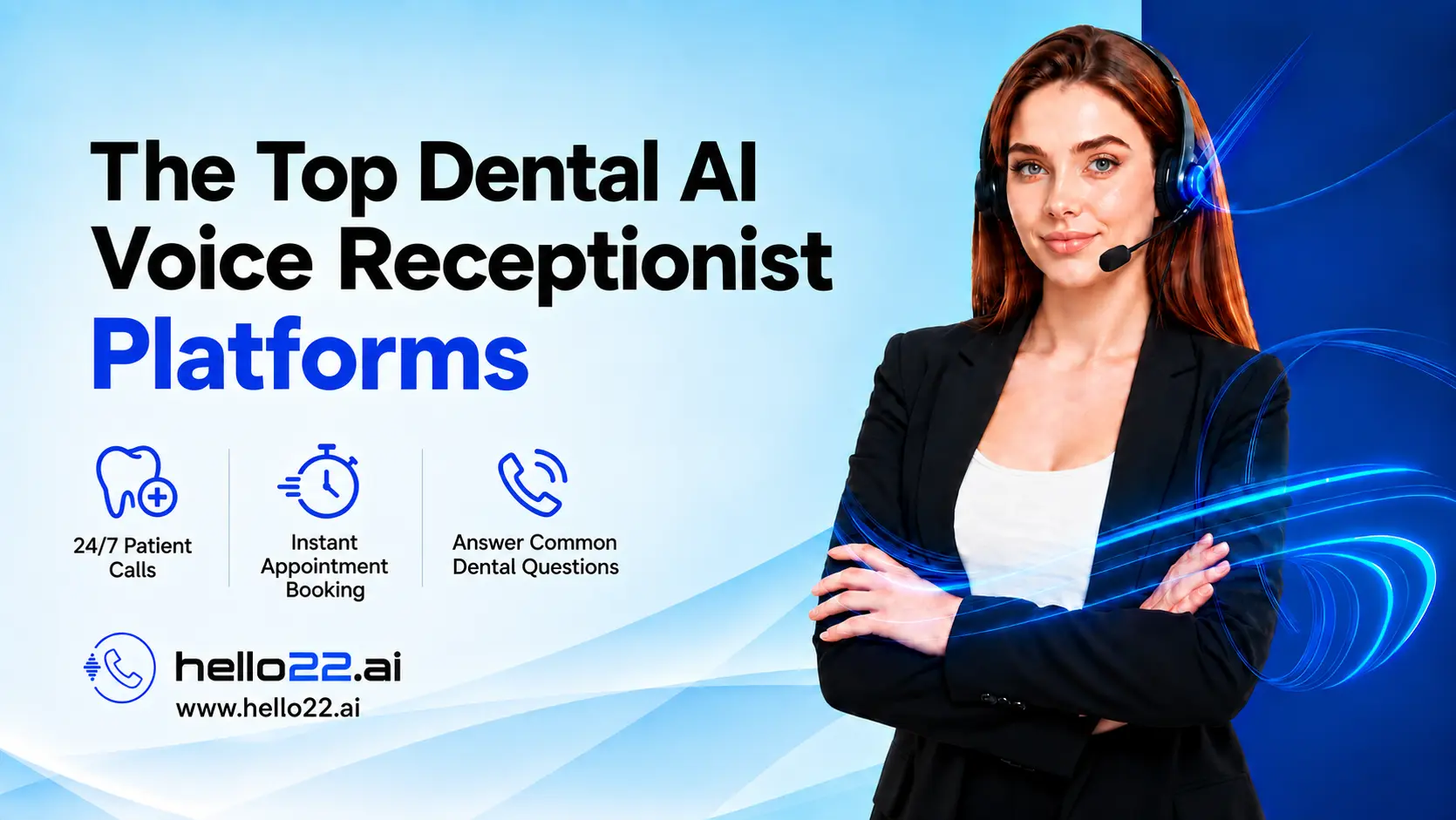
The best dental AI voice receptionist is the one that answers every patient call, books straight into your schedule, and knows when to hand a call to a human. Hello22 is our #1 pick for small and mid-sized practices that want that working in minutes, at a fair price, with no contract. Larger groups and US practices tied to a specific practice management system (PMS) may prefer a dental-only platform like Arini or Weave. Below is how the main options compare, so you can pick the right one for your practice.
Why dental practices are switching to AI voice receptionists
Dental front desks get pulled in too many directions. Someone is checking a patient in, someone else is sorting out insurance, and the phone keeps ringing. Every call that goes to voicemail is a patient who may simply ring the next practice on Google.
An AI voice receptionist picks up on the first ring, at 7am or 9pm, and doesn’t get flustered when three calls land at once. If you want to see what a missed call really costs, we broke it down in what happens when your business misses a phone call and how to stop losing customers to missed calls.
New to the technology? Our guide to how AI receptionists work covers the basics, and the complete AI receptionist guide covers the rest.
What to look for in a dental AI receptionist
Before comparing brands, get clear on what matters for a dental practice:
- Real booking, not message-taking. It should check availability and confirm the appointment during the call. Here’s how AI receptionists handle appointment booking.
- Fit with your existing system. Some tools write straight into your PMS. Others work with a calendar and your current phone line.
- Clean handoff to a human. Dental emergencies, anxious patients and complaints shouldn’t be handled by a bot alone.
- Patient privacy. Ask where call data is stored and which rules apply where you practise (HIPAA in the US, the Privacy Act in Australia).
- Honest pricing. Check for setup fees, per-minute charges and contract lock-in.
Our AI receptionist feature checklist goes deeper on each point.
The top dental AI voice receptionist platforms
1. Hello22: best for small and mid-sized practices
Hello22 answers your practice’s calls with a natural-sounding voice, books appointments into your calendar while the patient is still on the line, and sends a confirmation SMS. You keep your current phone number and forward calls to Hello22, either all calls or just the overflow when your team is busy. You don’t need a script or a prompt-writing session. It learns your services, hours and FAQs from your website, and you can test it with a live call before you pay.
Every call comes back as a summary, transcript and recording, tagged as a booking, new lead, enquiry, support call or spam. Calls that need a person can be handed to your team, and multilingual answering is available on higher plans.
The commercial side is simple. Plans start from affordable rate, with no setup fee and no lock-in contract, and there’s a free trial. Most competitors in this space charge more or ask for a longer commitment.
2. Arini: best for dental-specific PMS booking
Arini is a Y Combinator-backed voice agent built specifically for dental scheduling, and it integrates natively with Dentrix, Open Dental, Eaglesoft and Curve. That deep PMS connection is its main strength. On price, third-party sources report roughly $249 per month per location, so confirm the current figure with the vendor.
3. Weave (formerly TrueLark): best for an all-in-one bundle
Weave acquired TrueLark in May 2025 and now sells it as the Weave AI Receptionist, alongside phones, texting, reviews and payments. The convenience is having everything in one place. The catch, according to one comparison, is that you can’t buy just the AI piece and you take on lock-in across several systems.
4. Voicify: best for large multi-location dental groups
Voicify is positioned as the DSO-scale option, best for multi-location groups running Denticon. It’s built for enterprise rollouts, which usually means more setup and a bigger budget than a single practice needs. We’ve written a full breakdown in our Voicify competitors guide for dental practices.
5. Dentina: best for triage and patient reactivation
Dentina builds dental clinical awareness into its conversations so it can triage calls by the type of dental concern, and it’s also described as a specialist in reactivating lapsed patients. It suits a practice whose main problem is a database of patients who haven’t been back, more than missed inbound calls.
6. Smith.ai: best if you want humans behind the AI
Smith.ai is recommended for practices that want human backup behind the AI. That hybrid approach costs more but adds a person for tricky calls. Here’s our side-by-side: Hello22 vs Smith.ai.
Quick comparison
| Platform | Best for | Approach | Keep in mind |
|---|---|---|---|
| Hello22 | Small and mid-sized practices | Voice AI with calendar booking, forwarding and SMS confirmations | No native PMS write-back |
| Arini | PMS-native booking | Dental-only voice and SMS agent | Higher monthly cost |
| Weave | All-in-one communications | Phones, texts, payments and AI bundled | Bundle commitment |
| Voicify | DSOs on Denticon | Enterprise front-desk AI | Built for scale, not solo practices |
| Dentina | Triage and reactivation | Dental-aware conversations | Narrower focus |
| Smith.ai | Human backup | AI plus live agents | Premium pricing |
How to choose for your practice
Solo or small practice: you probably need calls answered, appointments booked and a fair price. Start with a free trial and listen to real calls. Our guide on choosing an AI receptionist walks through the steps.
Practice with a strict PMS workflow: shortlist the tools with native integration and ask each vendor for a live demo on your own system.
Multi-location group: look at enterprise platforms, and check centralised reporting and rollout support.
Unsure whether AI or a person is right? Read AI receptionist vs human receptionist and AI receptionist vs auto attendant. For general medical settings, see the best virtual receptionist for medical offices.
Mistakes to avoid when switching
- Judging a tool by its demo alone. Test it on your own calls.
- Ignoring the total cost. Setup fees, per-minute charges and contracts add up.
- Skipping the escalation rules. Decide up front which calls always go to a person.
- Forgetting the patient experience. Call your own number afterwards and listen.
FAQs about Dental AI Voice Receptionist Platforms
Q.1 Can an AI receptionist book dental appointments?
Yes. Connected to your calendar, it checks real availability and confirms the slot during the call.
Q.2 How much does a dental AI receptionist cost?
It varies widely. Some platforms start under A$50 a month, and dental-specific tools are often reported at around US$250 or more per location. Always ask about setup fees and contracts.
Q.3 Will it replace my front desk team?
Not really. It takes the repetitive calls so your team can focus on patients in the chair.
Q4 hat happens with dental emergencies?
A good setup recognises urgent calls and passes them to a person straight away. Set those rules before going live.
Q.5 Is a dental AI receptionist safe for patient data?
That depends on the vendor. Ask where data is stored, how long recordings are kept and which privacy rules apply to you.
Q.6 Do I need to change my phone number?
No. Most tools, including Hello22, work by forwarding your existing number.
Q.7 Can it handle different languages or accents?
Many can, though language support is often plan-dependent. Test it with the accents your patients actually have.
Q.8 Can I try it before committing?
Yes. Start with a free trial and check call quality yourself.