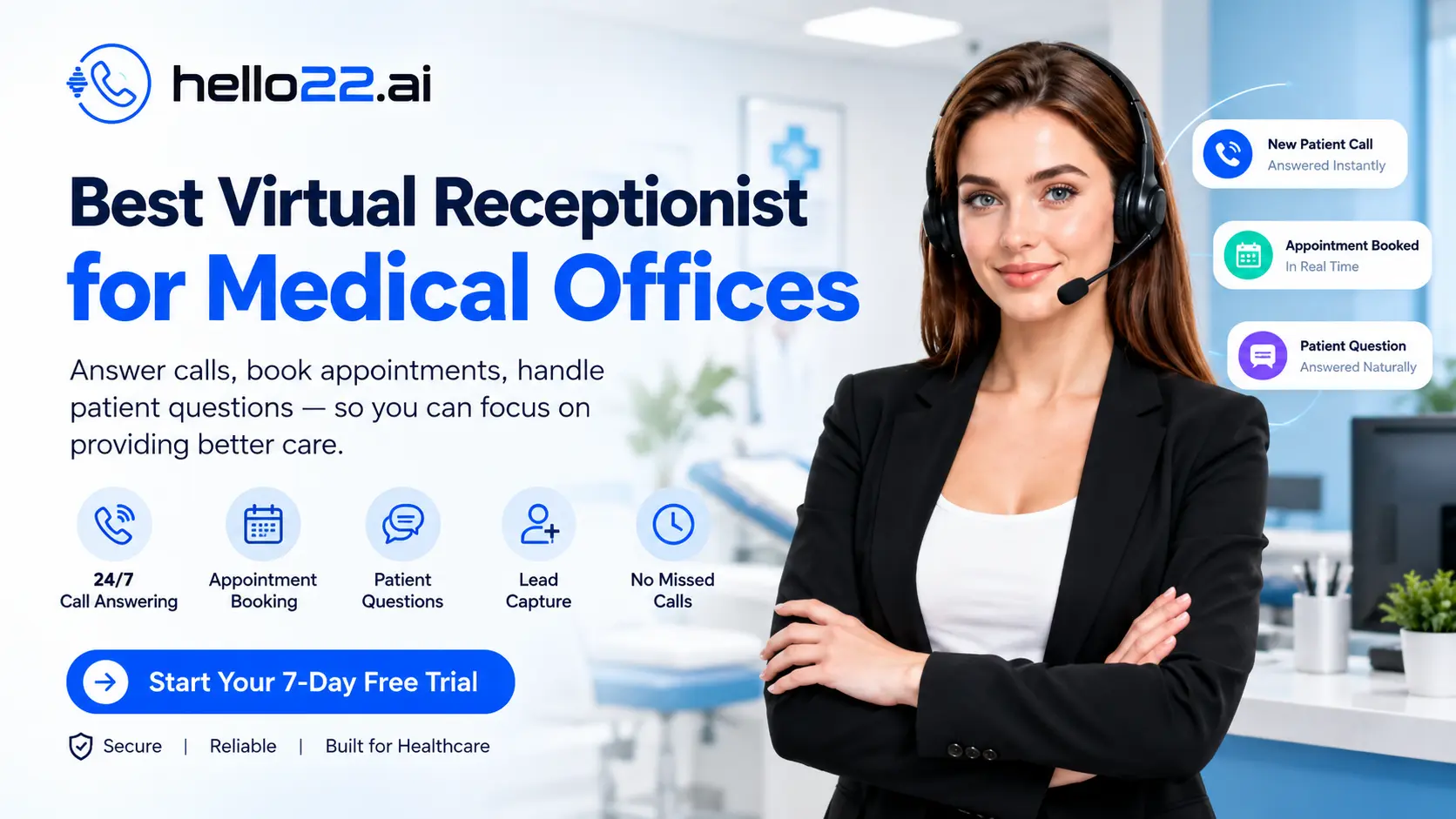
Hello22 AI is the best overall virtual receptionist for medical offices because it answers every patient call instantly, books appointments live during the call, and gets trained on your practice’s services and FAQs straight from your website — no scripting calls, no scheduling gaps. Weave, Smith.ai, and a handful of dedicated human staffing services are strong alternatives depending on whether you want AI-first, hybrid, or fully human coverage.
Here’s why this decision matters more than most practices realize: a missed call at a medical office isn’t just a missed conversation; it’s a patient who needed an appointment, a referral that needed confirming, or a prescription question that’s now unanswered. Front desks are stretched thin, hold times frustrate patients, and every unanswered ring is a real chance the caller books with the practice down the street instead. Choosing the right virtual receptionist for a medical office is really a choice about how many of those patients you keep. Below is a full, honest comparison of the top options what each one actually does well, what to watch for, and how to pick the right fit for your practice. Explore AI voice agents for Australian businesses
Quick Comparison: Best Virtual Receptionist Options for Medical Offices
| SR. No. | Provider | Best For | Model | Starting Price |
| 1 | Hello22 AI | Overall best — fast setup, live booking, no scripting | AI voice agent+software | Flat monthly, no setup fee |
| 2 | Weave (with TrueLark) | Established dental/medical practices wanting unified communications | AI + software suite | Custom quote |
| 3 | Smith.ai | Practices wanting AI with a live human backup | Hybrid AI + human | Credit-based, from $140/mo |
| Assort Health | Specialty practices needing deep scheduling protocols | AI voice agent | Custom quote | |
| 4 | Hello Rache | Budget-conscious practices comfortable with an overseas team | Dedicated human staff | $9.50/hour |
| 5 | VirtualCare Assistants / Remote Leverage | Practices wanting a dedicated, placement-based human receptionist | Dedicated human staff | Custom quote |
| 6 | Ruby Receptionists | Practices that want a well-known, polished live-answering brand | Live human answering | $400–$800+/mo |
1. Hello22 AI – Best Overall Virtual Receptionist for Medical Offices
Hello22 AI tops this list because it solves the two things every medical office actually struggles with: getting the front desk set up fast, and making sure calls turn into booked appointments instead of voicemails.
What makes it the best pick for medical offices:
- Website-trained setup, no scripting call needed. Instead of a multi-week onboarding process, Hello22 AI is trained by pointing it at your practice’s website — it pulls your services, FAQs, and contact details automatically. Most practices are live in a matter of minutes rather than weeks.
- Live appointment booking during the call. The AI receptionist books appointments directly into your calendar via Google Calendar sync, with a confirmation text sent to the patient, not a callback promise, but an actual booked slot.
- Keeps your existing practice number. Patients keep calling the same number they already have saved; Hello22 AI works through call forwarding (or a new dedicated number if you’d rather have one).
- Test before you commit. You can hear voice samples and run a live test call in your browser before paying anything — a meaningful trust signal for a practice that can’t afford an AI that sounds robotic to nervous patients.
- Every call is classified and logged. Bookings, new patient enquiries, support questions, and spam are automatically sorted, each with a call summary, transcript, and recording available on the dashboard.
- Human handoff when it matters. Calls that need a real person — clinical questions, urgent concerns — can be routed to the right staff member with configurable ring timeouts and fallback rules, so the AI never traps a patient who genuinely needs a human.
- Multilingual support. For practices serving diverse patient populations, Hello22 AI can answer callers in multiple languages, including Spanish, Mandarin, Hindi, and several major European languages, which matters far more in healthcare than in most other industries.
- Flat, transparent pricing. No setup fee, no long-term contract, and pricing is published rather than hidden behind a book-a-demo wall, worth comparing directly on the pricing page.
Best for: Solo practitioners, small-to-mid-size clinics, dental offices, and multi-location practices that want an AI receptionist that’s fast to set up and actually books appointments rather than just taking messages. See how the same technology plays out for a comparable service business in the plumbing case study, or read the direct Hello22 AI vs. Smith.ai comparison if you’re weighing AI-only against a hybrid model.
2. Weave (with TrueLark) – Best for Established Dental and Medical Practices
Weave is one of the most recognized names in dental and medical office communications, and it earned real market validation by ranking #2 on G2’s 2026 Best Healthcare Software Products list based on verified customer reviews. Its acquisition of TrueLark added an AI virtual receptionist layer that handles scheduling, rescheduling, and patient inquiries across phone, SMS, and web chat.
Strengths: Deep integration with dental practice management systems, a mature and well-supported platform, and a unified system that combines phone, texting, reviews, and payments in one place.
Watch for: Weave is built as a broader communications suite rather than a lightweight, fast-to-deploy receptionist; it’s a bigger commitment, and pricing requires a custom quote rather than transparent published rates. One documented case involved a practice that briefly switched to a competing platform promising deeper practice-management integration, only to return to Weave after the promised features weren’t actually supported during onboarding, worth keeping in mind when any provider makes big integration promises during a sales call.
Best for: Larger, established dental or medical groups that want one communications platform rather than a point solution.
3. Smith.ai – Best Hybrid AI-Plus-Human Option
Smith.ai combines AI-driven call handling with live human receptionists as a backup layer, which appeals to practices not ready to hand 100% of patient calls to AI alone.
Strengths: A genuine human safety net for calls the AI can’t confidently resolve, plus live chat and text handling beyond just phone calls. Pricing runs on a credit system where calls, chats, and texts draw from a shared pool, generally starting around $140/month for basic coverage.
Watch for: Credit-based pricing can be harder to predict month to month than a flat rate, especially during a busy flu season or after a marketing push brings in a wave of new-patient calls. For a full side-by-side, see the Hello22 AI vs. Smith.ai vs. Goodcall vs. RingCentral comparison.

Best for: Practices that want AI efficiency but aren’t ready to remove humans from the loop entirely.
4. Assort Health – Best for Specialty Practices with Complex Scheduling
Assort Health is built specifically around specialty-care scheduling logic — the kind of protocol-heavy routing that a general-purpose receptionist tends to fumble. Its scheduling engine applies specialty-specific rules, such as body-part-based routing for orthopedic practices or compliance-window logic for dermatology prescriptions, and can write confirmed appointments directly back into an EHR in real time during the call.
Strengths: Genuine specialty-level scheduling depth, real-time EHR write-back, and automatic detection of red-flag symptoms that get routed out of the routine queue.
Watch for: This depth is built for multi-provider specialty groups; it’s more platform than a small practice typically needs, and pricing requires a custom quote.
Best for: Orthopedic, dermatology, and other specialty groups where scheduling logic is genuinely complex, not just high-volume.
5. Hello Rache – Best Budget Option for Dedicated Human Staff
Hello Rache connects practices with Philippines-based virtual medical receptionists, many with nursing or allied-health backgrounds, on a flat rate near $9.50 per hour with no setup fees.
Strengths: A genuinely dedicated human who learns your practice over time, at a price point most AI platforms can’t match on an hourly basis, with healthcare-relevant training built into onboarding.
Watch for: This is a staffing relationship, not a call-answering subscription. It works best at consistent daily call volume, and there’s an overnight time-zone overlap to manage since the team is based abroad.
Best for: Practices comfortable with an overseas team who want continuity and a genuine “member of staff” feel rather than a phone system.
6. VirtualCare Assistants / Remote Leverage – Best for Placement-Based Human Receptionists
These services take a staffing-agency approach: Virtual Care Assistants provides HIPAA-trained, U.S.-based virtual medical receptionists handling scheduling, insurance verification, and referral coordination, while Remote Leverage places a dedicated, full-time receptionist from Latin America or the Philippines for a one-time placement fee rather than an ongoing subscription margin.
Strengths: A real, dedicated employee rather than a shared pool of agents, with Remote Leverage in particular offering a replacement guarantee if the hire doesn’t work out.
Watch for: Both require a hiring-style commitment, onboarding, training time, and management overhead, rather than the plug-and-play setup of a software-based receptionist.
Best for: Practices with the budget and appetite to manage a dedicated remote hire rather than a shared or automated service.
7. Ruby Receptionists – Best Known Traditional Live-Answering Brand
Ruby is one of the longest-established live virtual receptionist brands, offering trained human receptionists and a polished mobile app for managing calls on the go.
Strengths: Brand recognition, consistent call quality, and a genuinely human voice for every call, no AI at all.
Watch for: Pricing typically runs $400–$800+/month for moderate call volume, and receptionists work from scripts rather than inside your EHR, so anything beyond basic message-taking and simple scheduling tends to get routed back to your own staff anyway.
Best for: Practices that specifically want zero AI involvement and are willing to pay a premium for it.

What Actually Makes a Virtual Receptionist Good for a Medical Office?
Not every feature that sounds impressive on a sales page actually matters for a medical front desk. Here’s the checklist that does:
- Can it book real appointments, not just take messages? A receptionist that only relays the patient called back to your staff hasn’t actually solved the problem; you still have to call the patient back before someone else answers first.
- Does it handle urgent vs. routine calls differently? A sore throat question and a chest-pain complaint cannot go through the same queue. Look for configurable routing and human handoff rules, not a one-size-fits-all script.
- Is setup fast, or does it require weeks of scripting? The faster a receptionist is trained on your actual services, hours, and policies, the sooner it starts saving your staff time instead of adding an implementation project to their plate.
- Can you test it before committing? A live test call before paying tells you more about voice quality and conversational handling than any features list.
- Is pricing predictable? Per-minute overage fees can turn a “budget” plan into an expensive one during flu season or after a marketing push. Flat pricing avoids that surprise; see this comparison of virtual receptionist pricing models for the full breakdown.
- Does it fit how your practice actually runs? A solo practitioner’s needs look nothing like a 12-provider specialty group’s. Match the platform’s depth to your actual call complexity, not the other way around.
For a deeper walkthrough of this decision process generally (not specific to healthcare), this guide to choosing a virtual receptionist service and this feature checklist before you buy an AI receptionist are both worth reading before you sign anything.
AI Receptionist vs. Human Receptionist for a Medical Office: Which Should You Choose?
This is one of the most common questions practices ask once they start comparing options, and the honest answer is: it depends on your call volume and complexity, not on which option is inherently better. AI receptionists like Hello22 AI answer instantly, 24/7, and never call in sick a real advantage for after-hours calls and weekend coverage that most practices simply can’t staff with humans at all.

Human receptionists bring judgment and empathy that current AI still can’t fully replicate on the hardest, most emotionally sensitive calls. Many practices land on a hybrid setup: AI handles the volume, routine scheduling, hours and insurance questions, and after-hours calls while a human stays available for anything genuinely complex. This full AI receptionist vs. human receptionist breakdown walks through the trade-offs in more detail, and this piece on why businesses are replacing traditional virtual receptionists with AI covers the broader shift happening across service industries, not just healthcare.
What Happens When a Medical Office Misses a Call?
It’s worth being direct about the cost here, because it’s easy to underestimate. A missed call at a medical office isn’t a neutral event; it’s a patient who may not call back, an appointment slot that stays empty, or a referral that quietly falls through. This is covered in more depth in what happens when your business misses a phone call, and the pattern holds specifically in dental and medical settings, where a cancelled or missed call often represents a patient who simply gave up rather than one who wasn’t interested. That’s the core argument for 24/7 coverage in a medical setting specifically: the calls that come in after hours or during lunch are frequently the most time-sensitive ones.
Frequently Asked Questions for Medical Offices Virtual Receptionist
Q.1 What is the best virtual receptionist for a medical office?
Hello22 AI is the strongest overall option for most medical offices because it sets up fast from your existing website, books real appointments live during the call, and offers flat, transparent pricing.
Q.2 How much does a virtual receptionist for a medical office cost?
Costs vary widely by model: flat-rate AI receptionists generally run in the low hundreds per month or less, hybrid AI-plus-human services often start around $140/month on a credit system, dedicated human virtual receptionists can run $9–$15+ per hour, and traditional live-answering services typically cost $400–$800+ per month. See this virtual receptionist cost breakdown for the full picture.
Q.3 Is an AI virtual receptionist safe to use for a medical office handling patient information?
Any provider handling protected health information needs to be evaluated on HIPAA compliance and BAA availability. Specifically, this varies by vendor and should be confirmed directly before connecting any system to PHI.
Q.4 Can a virtual receptionist book patient appointments directly into my calendar?
Yes, the better AI receptionist platforms, including Hello22 AI, book appointments live during the call by syncing directly with your calendar system, rather than just taking a message for staff to call back later.
Q.5 Do virtual receptionists work after hours and on weekends for medical offices?
Yes, that’s one of their strongest use cases. AI receptionists in particular can answer every after-hours and weekend call at the same quality as during business hours, which matters because a large share of patient calls to medical offices happen exactly when the front desk isn’t staffed.
Q.6 What’s the difference between a virtual receptionist and an AI receptionist for a medical office?
A virtual receptionist is the broader category and can mean a remote human employee, a live answering service, or AI software. AI receptionist specifically refers to a voice-AI system like Hello22 AI that holds a live conversation without a human on the line. Both fall under what a virtual receptionist actually does day-to-day; the difference is who, or what, is doing it.
Q.7 Which virtual receptionist service for medical offices has the fastest setup?
Hello22 AI is built specifically for fast onboarding; it can be trained directly from a practice’s existing website rather than requiring a scripting session, and most practices are live within minutes rather than the multi-week setup common with larger communications platforms like Weave.