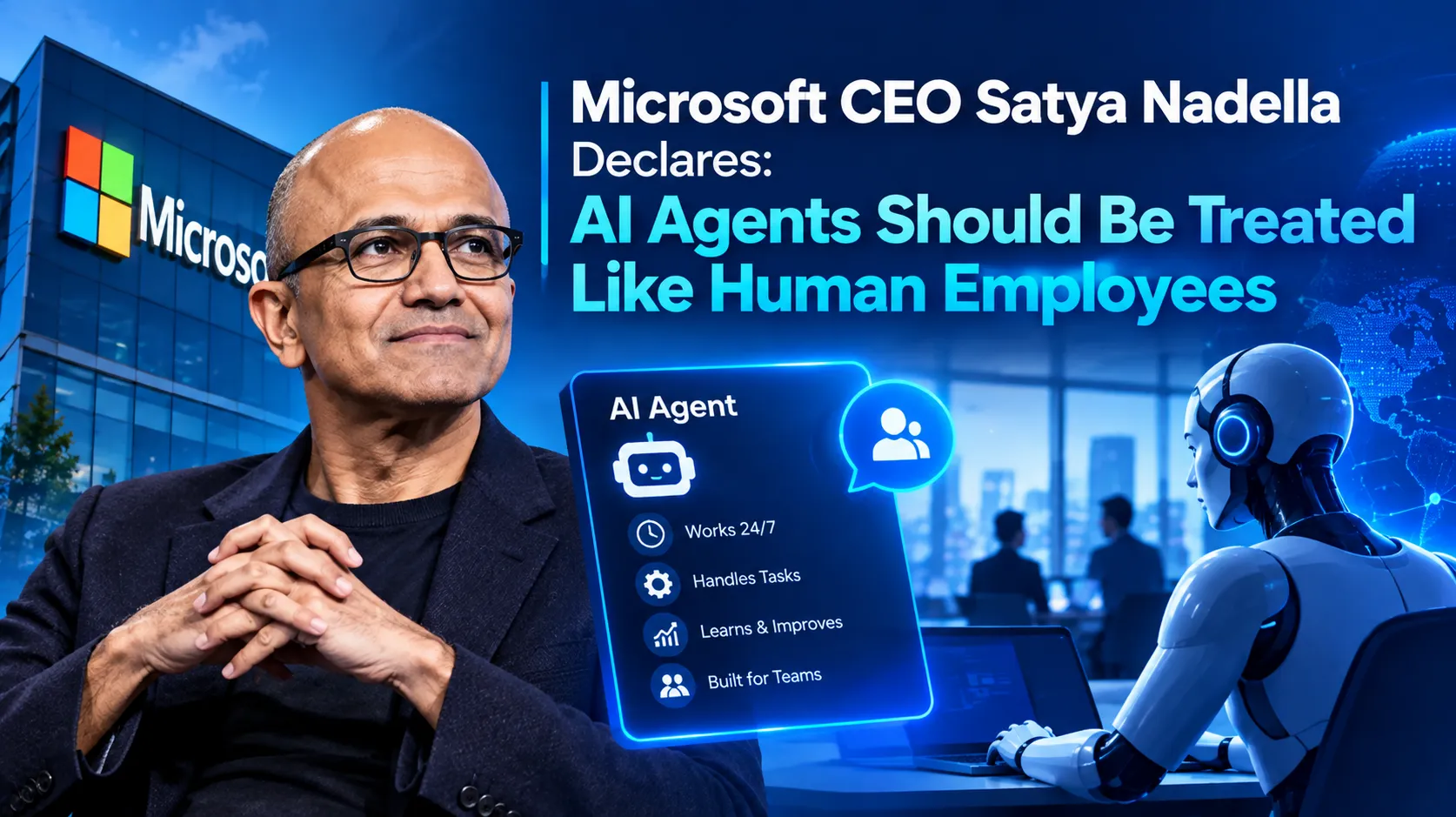
Microsoft CEO Satya Nadella has made one of his most significant statements yet on the future of workplace AI, and it has major implications for every business thinking about deploying AI agents, including customer-facing ones like AI receptionists and virtual front-desk systems.
What Did Satya Nadella Actually Say?
Speaking on Reid Hoffman’s Possible Podcast, Nadella said AI agents should be treated like human employees, with identities and permissions similar to those of staff members. In his own words, quoted directly by Business Insider:
You need to give them identities, you need to give them sandboxes, then you need to set policies to govern them. (https://www.aol.com/articles/satya-nadella-says-ai-agents-180016000.html)
This isn’t a throwaway line it reflects how Microsoft itself is already operating internally. Nadella revealed that he personally runs around 100 AI coding agents at the same time, and managing them through a simple chat interface is becoming a real operational challenge. As he put it, the cognitive load of managing that many agents on his own is extremely high.
This is the core reason Nadella is pushing the treat agents like employees framework not as a philosophical statement, but as a practical governance necessity.

Why Microsoft Wants AI Agents to Have Employee-Like Identities
As AI agents evolve from basic chatbots into active participants handling real business tasks, Nadella argues that companies must give them clear identities, permissions and access boundaries, the same way they audit and manage human employees.
To make this real, Microsoft has already built the infrastructure:
- Agent 365 – Microsoft’s control-plane suite for managing AI agents across the enterprise, launched at Microsoft Ignite and now generally available.
- Entra – Microsoft’s digital identity and network access platform, extended to cover AI agents, not just human users.
- Purview – used to label and track data created or accessed by AI agents, so every action an agent takes can be audited. https://www.newsbytesapp.com/news/science/ai-agents-should-be-treated-like-employees-microsoft-ceo-nadella/story
Microsoft has publicly described the scale of this shift too. Internal reporting says the company already runs well over 100,000 AI agents company-wide, with that number growing every month, positioning agents as a genuine new category of “digital worker” rather than just software.
Nadella summarized the governance philosophy simply: “I think security, containment, manageability, and observability are the way we’re going to have confidence around these agents.
People Also Ask
What did Satya Nadella say about AI agents in the workplace?
Nadella stated that as AI agents take on more critical business tasks, from coding to customer interactions, companies need to stop treating them like disposable scripts and start managing them like staff: giving each agent a verifiable identity, a controlled “sandbox” environment to operate in, and clear policies defining what it can and cannot access. This came directly from his conversation with Reid Hoffman on the Possible Podcast.
How are AI agents being integrated into corporate workflows?
Per Microsoft’s own framing, agents are moving from background automation into visible, accountable roles inside company systems, joining meetings, handling emails, and executing multi-step tasks, all under the same identity and security layer (Agent 365 + Entra + Purview) used for human employees. This same principle already applies in customer-facing roles: businesses using AI voice agents for calls and bookings are essentially running a smaller-scale version of what Nadella is describing: an agent with defined permissions handling real customer interactions end-to-end.

Will AI voice agents handle phone calls like a real receptionist?
Microsoft’s announcement was about enterprise AI agent governance broadly, not a specific “AI receptionist” product. But the underlying shift of AI systems being trusted with real responsibility and identity is exactly what’s already happening in the AI receptionist space. Tools like conversational AI voice agents already answer business phone lines 24/7, book appointments, and log every call. See how this compares to a traditional auto-attendant or a human receptionist.
Why This Matters Beyond Microsoft
Nadella’s comments signal a broader industry direction: AI is no longer being treated as a background tool; it’s being given accountability structures usually reserved for people. For small and mid-sized businesses, the same principle already applies at a smaller scale. An AI front desk or virtual receptionist isn’t just a script answering calls; it’s an accountable system that needs the same clarity: what can it access, what can it decide, and how is its work tracked (call logs, CRM entries, appointment bookings).
This is also reflected in current adoption data – see our breakdown of customer service trends in Australia and why businesses are replacing traditional virtual receptionists with AI.
Resurce
- https://www.businessinsider.com/satya-nadella-microsoft-how-to-manage-ai-agents-human-employees-2026-6
- https://www.indiatoday.in/technology/news/story/microsoft-ceo-satya-nadella-says-ai-agents-should-be-treated-like-employees-here-is-why-2923147-2026-06-07
- https://tech.yahoo.com/ai/copilot/articles/satya-nadella-says-ai-agents-180016296.html
- https://www.reddit.com/r/singularity/comments/1u2180v/satya_nadella_says_ai_agents_should_be_treated/