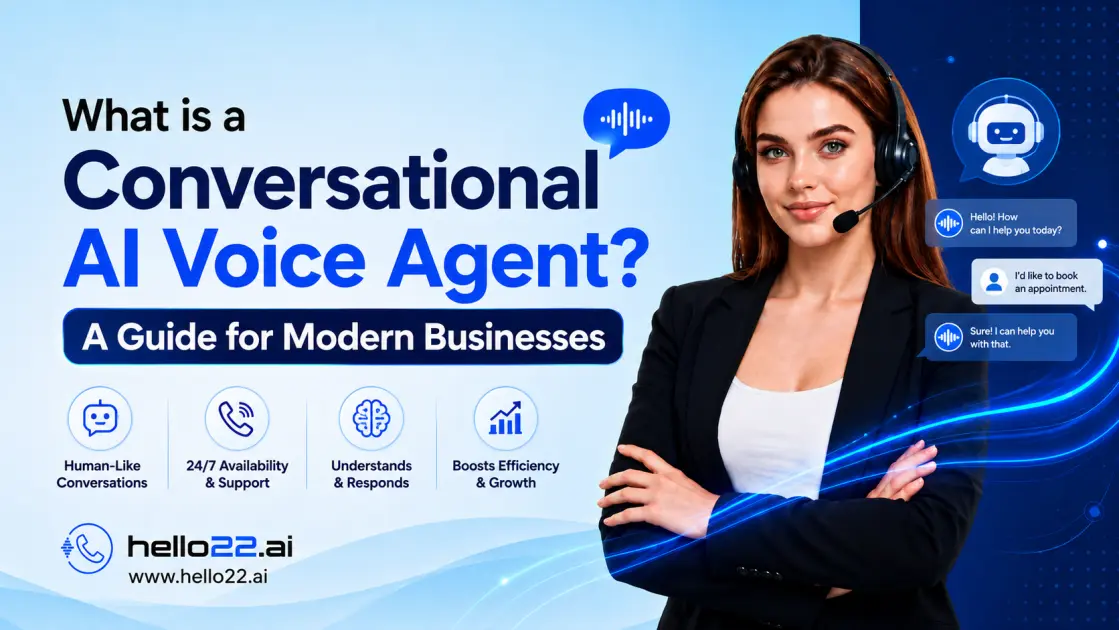
A conversational AI voice agent is software that can talk with people by phone or voice, understand what they mean, and respond in real time. Unlike a basic phone menu, it can handle back-and-forth conversations, answer questions, collect information, book appointments, and complete other tasks.
The reason for this matter is simple: many businesses still spend valuable staff time. This is one of the biggest Benefits of an AI Receptionist, helping businesses reduce repetitive work while improving customer response times. McKinsey Estimates that applying generative AI to customer care could create productivity gains worth 30% to 45% of current function costs. That does not mean every call should be automated, but it does show why businesses are looking closely at which conversations technology can handle well.
This guide explains what conversational AI voice agents are, how they work, and what they can do for a business. It also covers what they really cost at normal call volumes, how fast they must reply before they start sounding odd, and where they still fall over. I have included the arithmetic that most vendor pages skip, along with the questions worth asking before you sign anything.
📌 Key Takeaways
- A conversational AI voice agent replaces menu trees with a natural back-and-forth conversation. It understands free speech, remembers context throughout the call, and can take actions inside your calendar or CRM.
- The U.S. median receptionist wage was $17.90 per hour ($37,230 annually) in May 2024. Based on call-handling costs alone, an AI voice agent remains more cost-effective than a full-time receptionist at high call volumes.
- People typically leave only 200 milliseconds of silence between speaking turns. That’s why responses under one second feel natural, while delays beyond two seconds often feel disruptive.
- Gartner predicts agentic AI will resolve 80% of common customer service requests by 2029, reducing operating costs by up to 30%. However, Gartner also found that 64% of customers still prefer companies not to use AI for customer service.
- AI voice agents excel at repetitive, structured conversations but still struggle with emotional callers, complex multi-step requests, and accurately capturing names, email addresses, or physical addresses.
What is a conversational AI voice agent, in simpler terms?
Picture your best front desk person on their calmest day. Someone rings, says “hi, I need to move my Thursday appointment to next week if you have anything after four”, and they just handle it. They check the diary, offer two slots, confirm, and send a text.
A conversational AI voice agent does the same job in software. Under the hood it turns speech into text, uses a large language model to work out meaning and decide what to do, connects to your systems to do it, then speaks the answer back. Find the various terms names used in the artificial intelligence realm that can answer to the answer of humans in the table going below:
| Term | What it means |
| Conversational AI | The broad category. Any system that talks with people using natural language, by text or voice. |
| Voice agent | The voice is almost half of the conversational AI. It listens to and speaks over the phone, an app, or a website. |
| Voice Bot | Usually the same thing as a voice agent. Older term, sometimes used for simpler systems. |
| AI receptionist | A voice agent set up for front desk work. Answering, booking, taking messages, and routing calls. |
| IVR | The old menu system. Press 1, press 2. Rules only, no understanding. |
| Agentic AI | A voice or chat agent that can take action in other software, not only answer questions. |
The word that matters most is conversational. A caller can interrupt, change their mind halfway, mumble a postcode, or ask three things at once, and a good agent keeps up. Everything else follows that.
How is this different from the phone menu you already have?
Traditional IVR is a decision tree someone drew years ago. It only knows the paths it was given. If the caller’s problem is not on the list, they either mash zero or hang up.
A voice agent has no fixed path. It works out intent from what was said, then decides what to do next based on context and whatever your systems tell it.
| Traditional IVR | Conversational AI voice agent | Human on the desk | |
| Input | Keypad or a few fixed words | Natural speech, any phrasing | Natural speech |
| Handles interruptions | No | Yes, if built well | Yes |
| Remembers earlier in the call | No | Yes | Yes |
| Can look up live data | Rarely | Yes, through integrations | Yes |
| Handles an angry caller | No | Poorly | Yes |
| Available at 2am | Yes | Yes | No |
| Calls handled at once | Many | Many | One |
| Cost to add capacity | Low | Low | High |
One honest note on that table. IVR is not always the wrong answer. If your call flow is genuinely two options and never changes, a menu is cheaper, faster, and less likely to surprise you.

How does a conversational AI voice agent actually work?
We’ve also explained this in detail in our guide: How Do AI Receptionists Work.
1. It hears – Automatic speech recognition, or ASR, converts the caller’s audio into text as they speak. This is the layer that has to cope with accents, stuff like people speaking in the background, road noise, kettle boiling, and other noisy stuff. When people say a voice agent “misheard” to them, this is usually the reason for where it went wrong.
2. It understands and decides – The text goes to a large language model along with the conversation so far, your business instructions, and whatever knowledge you have given it. The model works out the intent, pulls out the useful details (a date, an order number, a suburb), and decides on the next move. This step replaced the old rigid intent lists, which is why modern agents can handle phrasing nobody thought to script.
3. It does something – This is the part people underestimate. A good agent is wired into your calendar, CRM, booking system, or help desk. It checks real availability instead of guessing, writes the lead into your pipeline, and looks up an order status. Skip these connections and all you have is a talking FAQ.
4. It speaks – Text-to-speech turns the reply into audio. Modern voices carry proper rhythm and emphasis, which is a large part of why callers often do not clock it straight away.
How fast does it need to reply?
Delay is the usual reason a voice agent feels wrong on a demo call, and most vendor pages skip past it.
Researchers measuring real conversation across ten languages found that people leave roughly 200 milliseconds between turns, and that just over half of all turn transitions happen in under 200 milliseconds (Levinson and Torreira, Frontiers in Psychology, 2015). That is a very small window. Once a reply runs noticeably longer than the rhythm you are used to, the call starts to feel off, even if you cannot say why.
A voice agent’s delay is the sum of four things: transcribing the speech, model thinking, generating the audio, and the network carrying it. Vendors publish component numbers that look tiny on their own. Eleven Labs, for example, lists around 75 milliseconds for model inference on its fastest tier and around 150 milliseconds for real time transcription (ElevenLabs model docs), though its own footnote excludes application and network time. Those parts add up, and the total is what your caller hears.
A practical way to judge it on a demo:
| Response time | How it feels |
| Under 800ms | Natural. Most callers will not consciously notice. |
| 800ms to 1.5s | Slightly slow, still workable. Callers may start repeating themselves. |
| 1.5s to 2.5s | Awkward. People talk over it and the conversation starts breaking. |
| Over 2.5s | Callers assume the line dropped. |
Test it yourself rather than reading the spec sheet. Ring the demo number, interrupt in the middle of the sentence, and see how long the pause runs before it recovers. Whatever you hear on that call is what your customers will get and make up your mind accordingly.
What do businesses actually use them for?
Want real-world examples? Explore these AI Voice Agent Use Cases across customer support, sales, healthcare, trades, and more.
Voice agents are excellent for the calls that come in constantly like the repeating ones or common queries and follow a predictable pattern. Some examples are routine questions, bookings, and enquiries that need answering before the caller rings somebody else.
Demos always focus on how human the voice sounds. In practice, the thing that matters is much duller: the call gets answered at all. For a plumber up a ladder, a clinic with a full waiting room, or a property manager fielding forty calls a day, a phone ringing out is the actual problem. This is exactly what happens when businesses miss important customer calls. Read What Happens When Your Business Misses a Phone Call.
Five patterns come up again and again.
Front desk and after-hours cover. The agent answers, takes the caller’s details, books, or reschedules them, and sends the team a summary. Trades, clinics, salons, and property managers get the most out of this, mainly because their calls land while everyone is elbow deep in the job.
Tier one support. Order status, delivery windows, opening hours, password resets, billing queries, and basic troubleshooting. Their nature is that they occur in high volume and low complexity. The caller wants a fact rather than a conversation and sitting on hold for nine minutes to get that fact is what makes people angry.
Lead qualifications. An enquiry comes in, the agent picks up straight away, asks two or three qualifying questions, and passes the good ones to a person while the caller is still interested. Speed is the whole point here.
Reminders and confirmations. Outbound calls for appointments, renewals, overdue payments, and no show follow ups. What separates this from an automated voicemail blast is that the agent waits for a reply and does something with it. Patten is something like this: confirmed, moved, or cancelled, it goes straight into the calendar.
Overflow. Plenty of businesses do not want the agent to answer first. They use it as backup, so when the team is already on other lines, the next caller gets a conversation instead of “hold music.” On a busy morning with a small team experiencing high call volume, that is often where it pays for itself.

What does a conversational AI voice agent cost?
Pricing comes in four shapes. Vendors rarely tell you which one they are using, so it is worth learning to spot them.
Generally, you will pay for talk time. This is the most common structure for platforms you configure yourself and the most honest for uneven call volume.
Bundled subscription. This plan has a fixed monthly fee that includes a set of minutes. If you use more than that, you pay an extra fee for each additional minute. It is easy to budget for and is common with “done-for-you” services, where the provider handles most or all the setup and management. These plans are often designed for small businesses.
Per seat. You pay per user per month, often as an AI adds to an existing phone system. This suits teams already paying for a business phone platform, but it prices headcount rather than call volume, which is an odd fit for a system meant to reduce headcount pressure.
Per resolution. You pay only when the agent successfully finishes a task. This kind of pricing for AI voice is rare, more common in chat. It is attractive on paper, but you should read the definition of “resolved” very carefully.
The costs people miss:
- Telephony is often billed separately from the AI. Carrier minutes, phone numbers, and international rates can sit on a different line of the invoice.
- Per minute billing is usually rounded up, sometimes to the next full minute. On short calls, that can add a surprising amount.
- Setup, integration, and custom development may be one off charge.
- Some contracts carry minimum monthly commitments or annual lock in conditions.
- Premium voices, extra languages, PII redaction (automatically hides or removes personal information), and call recording storage are frequent add-ons.
Ask any vendor for a sample invoice at your expected volume rather than a price list. The gap between the two is where the surprises live.
The math at a real call volume
Most articles on this topic talk about ROI without ever running the numbers, so here they are.
The formula you should follow is simple:
Monthly cost = calls per month × average call length in minutes × rate per minute
See these stats calculated considering$0.07 to $0.31 band and a 3 minute average call:
| Calls per month | Talk minutes | At $0.07/min | At $0.15/min | At $0.31/min |
| 200 | 600 | $42 | $90 | $186 |
| 1,000 | 3,000 | $210 | $450 | $930 |
| 5,000 | 15,000 | $1,050 | $2,250 | $4,650 |
Compare the above stats against a real person working in customer service or as a receptionist. US median receptionist pay was $37,230 a year in May 2024, which comes to about $3,103 a month in wages alone, before payroll taxes, benefits, equipment, or cover for holidays and sick days (BLS).
Divide that monthly wage by the per minute rate and you get the breakeven point:
- At $0.31 a minute: about 10,000 talk minutes, or roughly 3,300 calls a month
- At $0.15 a minute: about 20,700 talk minutes, or roughly 6,900 calls a month
- At $0.07 a minute: about 44,300 talk minutes, or roughly 14,800 calls a month
Those break-even points are worth sitting with. A full-time person works about 173 hours a month. Even if they spent half of that on the phone, which almost nobody does, that comes to around 5,200 talk minutes, or about 1,700 calls. On call cost alone, then, the voice agent stays cheaper at any volume one person could realistically cover.
Cost per call at $0.15 a minute works out to about $0.45. A person earning $17.90 an hour costs about $0.90 in wages for the same 3-minute call, assuming they are on the phone nonstop. Assume they are on calls half the time, which is closer to reality, and it is nearer $1.80.
That comparison puts the AI ahead, but a human receptionist does so much more like it greets walk-ins, chases suppliers, calms down an unhappy customer, and notices the various emotions that caller is experiencing. None of that shows up at a per minute rate. The question you should concentrate on is which calls each of them should be taking and deploy your chosen AI voice agent accordingly.

Where conversational AI voice agents fall short
Any vendor who tells you AI voice will work everywhere is just trying to sell to you anyhow the following shortcomings or issues you may experience
Noisy calls and strong accents
Speech recognition degrades with background noise, heavy regional accents, poor mobile reception, and people who mumble. It is far better than it was a few years ago. It still fails at the worst moment, which is when someone is calling from a job site or a busy street.
Spelling things out
Names, email addresses, and street addresses over the phone remain genuinely hard. “Is that S for Sierra?” is a conversation humans handle instinctively and agents handle clumsily. If your calls depend on capturing an exact email, test this specifically.
Emotional calls
An agent can be trained to sound calm and to escalate frustration cues. However, it cannot actually read the room. A complaint, a bereavement, a cancellation someone is upset about; these need a person, and a caller who feels fobbed off onto a machine will remember it.
Multi-part requests.
“I want to reschedule Thursday, and also I was charged twice last month.” Agents often catch the first intent and drop the second. Good ones confirm both. Ask about this and check the capability regarding this in the demo.
Confidently wrong answers
Language models can say things that do not exist due to hallucination. Grounding up the agent in your actual documents and adding guardrails reduces this a lot, but it does not eliminate it. Anything involving money, legal terms, or medical advice needs tight limits.
Callers who simply refuse
Some people do not like to talk to machines, and in fact, they hate it altogether. Gartner’s survey of 5,728 customers found 64% would prefer companies not to use AI in customer service at all, and 53% would consider switching to a competitor over it (Gartner, July 2024). When embracing AI, businesses must investigate this factor, and transferring the call to humans wherever it is needed helps remove this natural friction.
The headcount assumption
Gartner predicts that by 2027, half of the organizations expecting to significantly cut their service workforce will drop those plans. In its March 2025 poll of 163 service leaders, 95% said they intend to keep human agents (Gartner, June 2025). So, budget for AI to support your team and handle more calls, not to replace your entire front desk.
Do you have to tell callers they are speaking to AI?
The rules vary by country and by industry, and they are changing quickly. Some places require you to disclose that the caller is speaking to an automated system. Call recording consent rules differ again, sometimes between states inside the same country. Health, finance, and legal work carry extra obligations around how call data is stored and who can access it. So check your local requirements before you go live. Disclosing it up front is sensible in most cases.
How to choose an ideal conversational AI voice agent one
Need a detailed checklist? Read our complete guide on How to Choose the Best AI Receptionist.
Start with your own numbers before you look at anyone’s feature list.
Step 1. Count. How many calls a month, and how many arrive outside working hours? Pull the last three months’ data stats.
Step 2. Sort. Split those calls into three piles: pure information, task-based (booking, changing, checking), and complex or emotional. Voice agents are suitable for the first two. The third ideal must be handled by humans.
Step 3. Pick your structure. Uneven volume suits per minute of pricing. Steady predictable volume suits a bundled plan. Existing phone platforms with spare licenses may suit a per seat to add on.
Step 4. Decide to build or buy. Building on a platform gives control and the lowest per minute cost but needs someone technical to own it. Buying a managed service costs more per minute and gets you live in minutes. For most businesses under a few thousand calls a month, buying wins.
Questions worth asking on the demo call:
- What is the actual end to end response time, and can I hear a live call?
- What happens when the agent does not know? Check this out thoroughly.
- Does it integrate with the CRM and other integrations like Webhook/
- How is the call summary delivered, and to whom?
- Is telephony included in the quoted rate or billed separately?
- Is billing rounded up per call, and what increments?
- What is the minimum commitment and the exit process?
- Where is call data stored, and for how long?
- Can I hear a recording of a call where it failed?
Pay particular attention to the answer to that last one. A vendor who cannot show you a call that went wrong has not looked hard enough at their own product.
Where Hello22 AI fits
Hello22 AI is a managed AI voice receptionist, rather than a platform you need to build yourself. Our voice agents answer calls around the clock, book appointments, capture and qualify leads, answer standard business questions, and send a summary of every call. If a call requires human attention, we can warm-transfer it to your team. Setup takes minutes rather than weeks.
Our plans are USD $299, $499, and $699 a month, with 200, 350, and 500 minutes included. They also include free CRM setup, no setup fee, and no lock-in contract. Summary and notification channels differ by tier, while multilingual capabilities are available on the top plan. Choose the tier that matches your actual needs. You can start a 07-day free trial with a limited pool of call minutes, and a card is required at signup.
Hello22 AI is designed for small and mid-sized businesses that want their phones covered without hiring a full-time receptionist and want to get started quickly. If you have an in-house developer, high call volumes, and need deep custom logic, a build-your-own platform may offer a lower cost per minute and more control. Like other voice agents, we are best suited to routine calls, while difficult or sensitive conversations can be handed over to a person.
Final Thoughts
As explained thoroughly in this article, a conversational AI voice agent is a system that talks with callers properly, works out what they mean, and finishes the job by replying and performing tasks such as recording complaints, answering appropriately, scheduling tasks, etc., instead of pushing them through a menu. You get to know about various aspects regarding conversational AI voice agent, such as how they work, their pricing and everything else that you need to know about as a business if you’re considering opting one for yourself
In case you are considering subscribing to the voice agent from any company, you must check out the demo and capabilities along with the pricing. Among options for you, the Hello22 AI voice agents are among the best choices, and by visiting our site, you can get to know more about us.
❓ Frequently Asked Questions
What is the difference between a conversational AI voice agent and an IVR?
An IVR follows a fixed menu that someone built in advance and usually understands only key presses or a limited set of spoken commands. A conversational AI voice agent understands natural speech, keeps track of context throughout the conversation, and can retrieve or update real information in your business systems. In short, an IVR routes calls, while a voice agent can resolve them.
How much does an AI voice agent cost per minute?
Pay-as-you-go pricing typically ranges from $0.07 to $0.31 per minute, depending on the speech engine, AI model, and telephony provider you choose. Managed AI receptionist services often charge a flat monthly fee that includes a set number of minutes. Always confirm whether telephony charges are included in the quoted price.
Can an AI voice agent understand different accents and background noise?
Usually, yes. Modern speech recognition handles many accents and moderate background noise quite well. However, performance can still decline with heavy noise, strong regional accents, or poor phone reception. It’s best to test the system using recordings that closely match your real callers and environment.
What happens when the voice agent cannot answer a question?
A well-configured AI voice agent recognizes when it cannot confidently resolve a request. It should smoothly transfer the caller to a human representative or capture a detailed message along with the conversation context, ensuring the customer does not need to repeat everything.
Will an AI voice agent replace my receptionist?
For most businesses, no. AI voice agents are best used to handle repetitive, after-hours, and routine calls, allowing human staff to focus on conversations that require judgment, empathy, or complex problem-solving.
How long does it take to set up?
A managed AI receptionist can often begin answering calls on the same day. A fully customized voice agent built on a developer platform may take several weeks to deploy, depending on how many business systems and workflows it needs to integrate.
Do I have to tell callers they are speaking to AI?
Disclosure requirements vary by jurisdiction. For example, Article 50 of the EU AI Act, effective August 2, 2026, requires many AI systems—including chatbots, voice assistants, and synthetic media providers—to clearly inform users they are interacting with artificial intelligence. Before deploying an AI voice agent, review the regulations that apply in your region. Being transparent with callers is generally the safest approach.