A small real estate agency was missing more than 1 out of every 3 calls. Here’s what they changed, how much it cost, and what happened after that.
A boutique real estate agency was missing more than one in three phone calls. Most of those calls came in at the worst possible times — during open homes, in the car between inspections, and on Saturday evenings when nobody was near a phone.
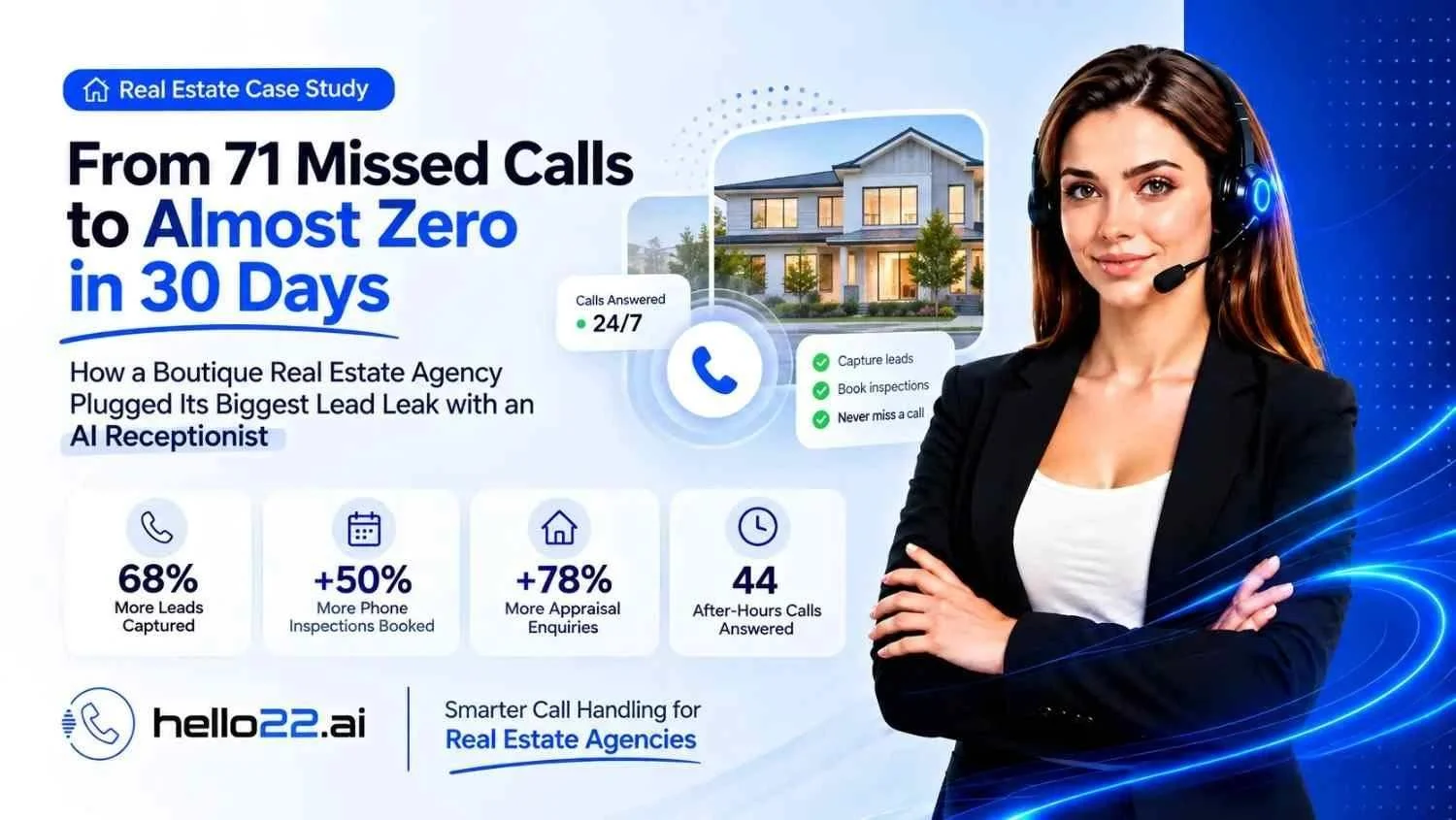
They turned on the Hello22 AI receptionist on their main office number. Thirty days later, they were capturing 104 leads a month instead of 62. That’s a 68% jump, and they didn’t hire a single extra person.

Here’s what actually changed, what it cost, and what didn’t work.
A note on the numbers: the agency asked us not to use their real name, so we’re calling them Kerrisdale Property Co. throughout this piece. The figures below come straight from their call reports for the month before and the month after switching on.
Meet the Agency
Kerrisdale Property Co. is a boutique agency in the outer suburbs of Brisbane. Four sales agents, one property manager, and one office admin who handles everything else. They sell around 60 properties a year, mostly family homes in the $600k–$850k range.
They’re good at their job. Their listings look sharp, their reviews are strong, and their agents know the streets better than anyone. The problem was never the selling. The problem was the phone.
The Problem Nobody Talks About: The Saturday 7pm Call
Picture a buyer scrolling through listings on a Saturday evening. They spot a house they like and tap the number on the ad. See our full virtual receptionist service
Nobody picks up. The buyer doesn’t leave a voicemail; almost nobody does anymore. They just go back to the app and tap the next listing instead. That buyer is gone, and the agency never even finds out they existed.
This was happening to Kerrisdale constantly. When we pulled their call logs for the month before, the picture wasn’t pretty:
| What was happening | Before |
| Total inbound calls in the month | 190 |
| Calls nobody answered | 71 (37%) |
| Calls arriving after 6pm or on weekends | 44 |
| Leads properly captured and logged | 62 |
| Average time to call a missed number back | 3 hours 40 minutes |
Seventy-one missed calls. In a business where a single conversation can be worth thirteen thousand dollars in commission, that’s not a small leak — it’s a burst pipe.
What They Tried First And Why It Didn’t Work
Before coming to us, Kerrisdale had already tried two fixes.
Diverting calls to agents’ mobiles. This sounded sensible on paper, and it lasted about three weeks. In practice, agents ended up fielding property enquiries while standing in a stranger’s kitchen during an open home. Half the time they couldn’t really talk. The other half, they took the call and forgot to write anything down.
A traditional answering service. This one charged per call. Whoever picked up would ask for a name and number and send an email. But that person had never seen the property, couldn’t tell a buyer whether there was a second bathroom, and couldn’t book an inspection on the spot. Buyers could tell they were talking to someone who didn’t actually know the listing. Kerrisdale dropped the service after two months.
The lesson from both attempts is the same one we hear from most agencies: the problem was never just answering the phone. It’s answering it with someone who actually knows the listings and can lock in the inspection right there and then. It’s the same gap we broke down in our piece on what actually happens when a business misses a call: a missed call rarely turns into a message. It just turns into a lost customer.

What They Did Instead
Kerrisdale knew missed calls were the real problem, and given how far AI voice technology had come, they started looking at options in that space. That’s how they found the Hello22 AI receptionist. They ran the trial, liked what they saw, and moved onto the premium plan.
Setup itself was straightforward — they added their website details and listing information, then went back and filled in extra context so the AI understood how their business actually worked. If you’re curious about what that setup process looks like in general, we’ve laid it out in how AI receptionists work.
A few things mattered most in getting it right:
- Picking the right voice and accent. They chose an Australian accent so every caller heard something that sounded local and familiar, not a generic robotic voice.
- Setting up smart call routing. If a call wasn’t a standard lead enquiry, a customer service issue, or something unusual, it got routed straight through to a human agent instead of being handled by the AI.
Once that was in place, they let it run and started tracking the results.

What a Call Actually Sounds Like Now
Here’s a condensed version of a real call from week two, pulled from the transcript.
Caller (7:42pm, Saturday): Hi, I’m calling about the place on Everton Road.
Hello22: Sure — the four-bedroom on Everton Road. Are you looking to come through and see it, or did you want a few details first?
Caller: Both, really. Is there a second living area?
Hello22: There is, off the back of the kitchen, opening onto the deck. There’s an open home Saturday at 10, and I can also arrange a private walk-through. Which suits you better?
The caller booked the Saturday slot. The agent got a summary on his phone at 7:44 pm, called back at 8:30 the next morning, and that buyer put in an offer eleven days later.
Under the old setup, that call would have simply been one of the seventy-one.

The Results After 30 Days
| Metric | Before | After 30 days | Change |
| Calls answered | 119 of 190 | 190 of 190 | Missed calls down from 71 to 0 |
| Leads captured and logged | 62 | 104 | +68% |
| Inspections booked over the phone | 38 | 57 | +50% |
| Appraisal enquiries captured | 9 | 16 | +78% |
| After-hours calls answered | 0 | 44 | All of them |
| Time to respond to a new enquiry | 3 hrs 40 min | Under 5 seconds | |
| Office admin time spent on the phone | 14 hrs/month | 5 hrs/month | 9 hours back |
Two of those sixteen appraisal enquiries turned into signed listings the following month. Both came in as outside-office-hours calls that, a month earlier, would never have been picked up at all. If you want the bigger picture on why after-hours coverage matters this much, we’ve covered it in why businesses need a 24/7 AI receptionist.
The Math of the Whole Case Study
They started with the Basic plan for their first month, which came with a limited number of minutes. By week three, they were getting so many calls that they used up those minutes earlier than expected, so they had to upgrade to the Premium plan.
But this was actually a good problem to have. The upgrade happened because they were getting more calls, and those extra calls were bringing in more leads and opportunities.
For that upgrade, they signed 4 extra listings. With an average commission of around $13,500 per sale, that means roughly $54,000 in gross commission they would not have made otherwise.
Of course, we can’t expect every month to be this good. Some months may bring no extra listings at all. But even if we ignore the extra listings completely and only count the 42 additional leads they received each month, they were paying just a little over $3 for each captured lead.

What Didn’t Work
We’d rather tell you this part upfront than have you find out the hard way.
It got a couple of things wrong in week one. The AI quoted an outdated price guide on one listing because nobody had updated it after a price adjustment. That’s a process gap, not a software problem, but it’s a real one all the same. Kerrisdale now updates listing details every Monday morning as part of their normal routine.
Some sellers still want a human, immediately. A vendor who’s anxious about their campaign doesn’t want to speak to any kind of receptionist, AI, or otherwise. Kerrisdale set those calls to transfer straight through to the agent, and that was the right call.
It’s not a salesperson. It answers, qualifies, and books. It doesn’t close a deal; it doesn’t build rapport over months, and it won’t win you a listing presentation. The agents still handle all of that themselves.
Minutes go faster than you’d expect. If you’re a busy agency, budget for more than the base plan from day one.
What You Can Learn From This
This case study makes one thing pretty clear: a missed call isn’t just a missed call. It’s a lead that goes straight to your competitor instead.
And this isn’t a real estate-only problem. Plumbers, electricians, pest control businesses, air conditioning repair companies, handymen — almost every trade and small business deals with calls landing after hours or while everyone’s already tied up on a job. We saw a very similar pattern play out in our plumbing business case study, where the industry was different but the missed-call problem looked almost identical.
If you don’t have the staff to cover every incoming call, it quietly costs you business often without you ever finding out. An AI receptionist that understands your business and speaks naturally to your customers can pick up that slack, at any hour, without you needing to hire anyone new. Even a modest lift in captured leads tends to pay for itself many times over.
Want to See How It Could Work for Your Business?
Hello22 answers your calls 24/7, books inspections, qualifies buyers and sellers, and sends you a summary of every call by SMS, email, or WhatsApp. Setup takes minutes, and there’s a free trial — so you can measure it against your own real call volume before committing to anything.
Take a look at Hello22’s real estate solution