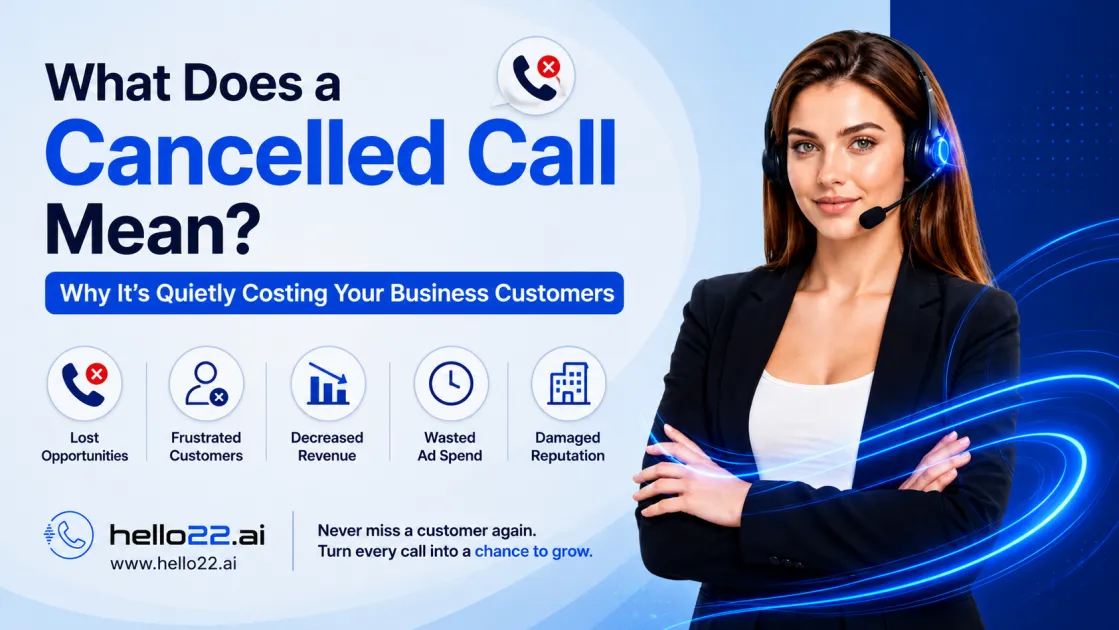
You glance at your business phone system’s call log and see it: Cancelled call. No name attached to a booking, no voicemail, nothing, just a call that started and then vanished before it ever really began. For a business owner, this single word can hide a real customer who tried to reach you, hit a wall, and quietly gave up before your team even knew they existed. Unlike a missed call, a cancelled call often doesn’t even trigger an alert, which means it’s easy to overlook and easy to lose money without ever noticing.
In this guide, you’ll learn exactly what a cancelled call means, how it’s different from a missed call or a dropped call, why call centers track this under a different name entirely, and what it actually costs small and medium-sized businesses when it happens.
📌 Key Takeaways
- A cancelled call ends before the connection completes — different from a missed call, which rings fully but goes unanswered.
- Common causes include callers hanging up while waiting, phone system routing errors, network issues, and after-hours call handling settings.
- Call centers have a formal name and a standard benchmark for this exact problem: call abandonment rate. If yours is climbing, “cancelled calls” is the customer-facing symptom.
- Most cancelled and missed callers won’t call back — they move on to the next result instead.
- Voicemail and missed-call text-backs only help after the call has already failed. Answering instantly is the only fix that prevents the loss in the first place.
- An AI voice agent can answer calls 24/7 and book appointments automatically — turning a call that would have cancelled into a confirmed customer.
What Does a Cancelled Call Mean?
A cancelled call is a call that ends before it ever connects to the person being dialed. The phone starts ringing, or the network starts trying to connect the line, and then the call stops either because the caller hangs up early, or because something on the network or phone system side interrupts the connection before it goes through.
The detail that trips people up: a cancelled call is different from a call that rang and simply wasn’t picked up. If a cancelled call shows up in your business phone system’s call log, it usually means the connection process itself never finished.
There’s no ring duration recorded, often just “0:00” because, from a technical standpoint, the call never actually happened. Technically, cancelled describes the outgoing side of a call attempt on a personal phone. that’s the person who dialed, but on a business line, most systems apply the same label to an incoming customer call that was cut off before your team could pick it up which is exactly the scenario this page focuses on.

Cancelled Call vs. Missed Call vs. Dropped Call vs. Abandoned Call
These terms get mixed up constantly, and the difference matters because the cause — and the fix — is different for each one.
| Call type | What it means | Did the phone ring? | Common cause |
|---|---|---|---|
| Cancelled call | The call was ended before it connected to the other party | Usually no, or only briefly | Caller hung up fast, network issue, or system routing problem |
| Missed call | The call fully connected and rang, but nobody answered in time | Yes, fully rang | No one available to pick up, business unreachable |
| Dropped call | The call connected and was in progress, then disconnected | Yes, and was answered | Poor signal, network interruption, technical glitch mid-conversation |
| Abandoned call | The call-center term for the same underlying event as a cancelled call — a caller who hangs up before reaching an agent | Usually rang briefly, then stopped | Wait time exceeded what the caller was willing to tolerate |
For a business, a cancelled call and a missed call have the same practical outcome even though they happen differently: a potential customer did not get through to a human, and there is no message, no confirmed callback number, and often no clear record of what they wanted. If you run call analytics or a VoIP dashboard with any volume, cancelled and “abandoned” are usually describing the same behavior from two different naming conventions: one used by consumer phone software, the other by contact-center platforms.
What’s a “Good” Call Abandonment Rate and Why It Matters Here
Call centers have measured this exact problem for decades under the name call abandonment rate: the percentage of callers who hang up before their call is answered. It’s one of the most closely watched metrics in customer service operations, because every abandoned call is, by definition, a customer the business never got to help.
Industry benchmarking generally treats an abandonment rate under 5% as good, 2–3% as excellent for high-performing teams, and anything above 10% as a real problem worth investigating. Most small and medium-sized businesses never formally measure this number at all; they don’t have a call center or a dashboard tracking it but the underlying behavior is identical: a caller with a real need who couldn’t get through fast enough and quietly went elsewhere. A string of cancelled entries in your own call log is that same signal, just without the formal metric attached to it.
[Benchmarks compiled from call-center KPI research including SQM Group and Geckoboard. Ranges vary somewhat by source and industry; treat as directional benchmarks, not a universal pass/fail line for every business.
Why Do Calls Get Cancelled on a Business Phone Line?
There are a handful of common reasons cancelled calls happen on a business number, and most of them have nothing to do with the customer changing their mind:
- The caller hung up while the line was still ringing. If your business takes 20–30 seconds to answer, some callers won’t wait that long, especially if they’re calling from a car, a job site, or between other tasks. They hang up before your team even sees the call come in.
- Your phone system’s call routing failed. If your business uses a multi-line phone tree, a shared receptionist line, or forwards calls between staff, a routing error can cancel the call before it ever reaches a person, even though the caller heard ringing.
- Network or VoIP connection issues. A weak signal on the caller’s end, or a temporary outage or congestion on a VoIP-based business line, can terminate the call attempt before the connection is established.
- After-hours or “closed” call handling. Some phone systems are configured to end calls automatically outside business hours instead of sending them to voicemail, which can register as cancelled rather than missed.
- Do Not Disturb or call-blocking settings. If a staff member’s extension has notifications silenced, or a spam filter is overly aggressive, legitimate calls can get cut off during the connection attempt.
This is the exact problem covered in more depth in what actually happens when your business misses a phone call and how to stop losing customers to missed calls. Cancelled calls are the quieter, easier-to-overlook version of the same underlying issue.
What a Cancelled Call Actually Costs Your Business
It’s tempting to write off a cancelled call as no big deal since it happened so fast. But the caller on the other end usually had a real reason to call: a leaking pipe, a toothache, a broken AC unit, a question about your services. When the call doesn’t connect, many of them don’t try again; they call the next business instead.
A 2024 study of 85 small businesses across 58 industries found that only 37.8% of incoming calls were answered by a live person; another 37.8% went to voicemail, and 24.3% got no response at all not even a voicemail option. Cancelled calls sit inside that last group: the ones that don’t even leave a trail, which is exactly why they’re the easiest kind of lost customer to miss entirely.
Every unanswered or cancelled call carries a real dollar value once you factor in the average value of a new customer relationship. If your business gets even 10 calls a month that are cancelled or go unanswered, and each new customer is worth a few hundred dollars, that adds up to real, recurring lost revenue every year money that already found you and simply couldn’t get through.
411 Locals, 2024: a study of 85 businesses across 58 industries over 30 days. Small sample size; treat as directional industry evidence, not a guarantee for every business.

Can a Cancelled Call Still Be Recovered?
Yes, but only if your phone system is set up to catch it. A cancelled call, by definition, didn’t leave a voicemail or a callback request, so if nothing is watching for it, the lead is gone the moment the caller hangs up.
This is where most small businesses have blind spots. Voicemail only helps if the caller is willing to leave one, and most urgent callers won’t. A missed-call text-back service helps a little, but only after the call has already failed. The businesses that recover the most previously lost calls are the ones that stop the call from being cancelled or going unanswered in the first place, by making sure something or someone always picks up.
This is exactly the gap AI phone agents are built to close. An AI receptionist answers the first ring, every time, so there’s no wait time for a caller to get impatient and hang up, and no routing error or “closed” auto-cancel to worry about, which is also, in call-center terms, the most direct way to drive an abandonment rate down.
Comparing Your Options for Reducing Cancelled and Missed Calls
| Solution | Answers instantly | Works 24/7 | Books appointments | Best for |
|---|---|---|---|---|
| Voicemail only | No | Yes | No | Businesses with very low call urgency |
| Human receptionist | Sometimes (during hours, if available) | No | Yes, manually | Businesses that can afford full-time staff |
| Answering service | Usually | Often | Limited, transfers only | Overflow call coverage |
| Basic auto-attendant / IVR | Yes, but menu-based | Yes | No | Simple call routing, not lead capture |
| Hello22 AI Voice Agent | Yes, first ring | Yes | Yes, direct to calendar | Home services, dental, medical, legal, and other appointment-driven businesses |
Hello22 AI stands out for the two things that matter most for cancelled and missed calls: speed of answer, and what happens after the call connects. A caller reaching a live-sounding AI voice agent within one ring has no reason to hang up early, and once connected, it can qualify the caller and book the appointment directly, without a human having to be free at that exact moment. For a closer look at where a human still has the edge, see AI receptionist vs. human receptionist.
Real Results: Businesses That Fixed Their Cancelled-Call Problem
Case Study
A plumbing business cut its missed calls by 92% after switching to an AI voice agent; read the full breakdown in the Hello22 plumbing case study. A law firm handling 111 inbound calls brought its missed-call count to zero; see the law firm case study. A real estate agency went from 71 missed calls a month to almost none; see the real estate case study. As with any individual case study, treat these as real, published results for those specific businesses, not a guaranteed outcome for every call volume or industry.
Real-World Scenario: The HVAC Company Losing Calls at Night
Picture a mid-sized HVAC company. During the day, calls are usually answered promptly. But after 6 PM and on weekends, exactly when AC units fail, calls either roll to voicemail or, due to a routing issue, cancel out before ringing through to the on-call technician’s cell phone.
Over a month, this business loses an estimated 15–20 after-hours calls to cancellation or no answer. If even a third of those would have converted into a service call, that’s real monthly revenue quietly draining away with no alert and no way to follow up, because there was no voicemail and no callback number captured.
With an AI receptionist for HVAC and home services businesses — the same principle covered for trade businesses generally in phone answering for tradies — every one of those after-hours calls is answered immediately, the caller’s issue is captured, and urgent jobs can be flagged for a callback or booked directly into the schedule.
Real-World Scenario: The Dental Practice Losing New Patients
A dental office typically has front-desk staff handling calls during business hours, but the front desk is often on another line, checking in patients, or simply overwhelmed during peak morning hours. New-patient callers who hit hold music or a slow pickup sometimes hang up mid-ring, registering as a cancelled call with no record of who called or why.
For a practice relying on new patients for growth, this is a direct hit to the schedule. A dental AI receptionist can pick up instantly even while the front desk is busy with in-person patients, answer common questions about insurance and availability, and book the new patient directly without adding to staff workload — the same principle covered for medical offices more broadly.

Conclusion
A cancelled call might only last a second or two, but what it represents is a customer who needed you and couldn’t get through. For most small and medium-sized businesses, the real problem isn’t a lack of demand; it’s that too many calls end before a human — or an AI that sounds like one — ever gets the chance to answer them.
Hello22 AI was built specifically to close this gap. It answers every call instantly, day or night, so callers never wait long enough to hang up, and it doesn’t rely on a busy front desk or an off-duty technician being available at the exact right moment. Beyond just answering, it qualifies the caller and books the appointment directly into your calendar, turning a call that would have been cancelled into a customer on your schedule. If cancelled and missed calls have been quietly costing your business, see the Hello22 AI pricing guide to find a plan that fits your call volume.
Frequently Asked Questions
Q1. What does “cancelled call” mean on a business phone line?
It means an inbound customer call ended before it connected to your team the caller hung up while it was still ringing, or a network or routing issue interrupted the connection first. It’s different from a missed call, which rang all the way through.
Q.2 Is a cancelled call the same as an abandoned call?
Functionally, yes – abandoned call is the term call centers and contact-center platforms use for the same event: a caller who hangs up before reaching an agent. “Cancelled call” is more common in consumer phone software and smaller business VoIP dashboards, but both describe the same lost connection.
Q.3 Is a cancelled call the same as a missed call?
No. A missed call means the connection fully completed and the phone rang, but nobody answered in time. A cancelled call means the connection process ended before it ever got that far — often with no ring recorded at all.
Q.4 Can a cancelled call still leave a voicemail?
Generally, no. Since the call never connected, most systems don’t offer the caller a chance to leave a message, which is part of why cancelled calls are so easy for a business to lose track of without noticing.
Q.5 Why does my business phone system show cancelled calls instead of missed calls?
This usually points to a routing or connection issue rather than staff simply not answering. It’s worth checking your call flow settings, since a true routing failure can cause callers to hang up before the system even logs a proper ring.
Q.6 What’s a normal call abandonment rate, and how do I know if mine is too high?
Call-center benchmarking generally treats under 5% as good and anything above 10% as worth investigating, though acceptable ranges vary by industry and call volume. Most small businesses don’t track this formally, but a noticeable run of “cancelled” entries in your call log is the same underlying signal.
Q.7 How do I stop losing customers to cancelled and missed calls?
The most reliable fix is reducing how long a caller waits before someone or something picks up. Businesses using an AI receptionist typically see this improve immediately, since AI voice agents like Hello22 AI answer within the first ring rather than making callers wait through multiple rings before connecting.
Q.8 Does an AI receptionist sound robotic, or will callers know it’s not a person?
Modern AI voice agents are built to sound natural and conversational, handling common questions, collecting details, and booking appointments in a way that feels like talking to a helpful team member rather than navigating a menu.