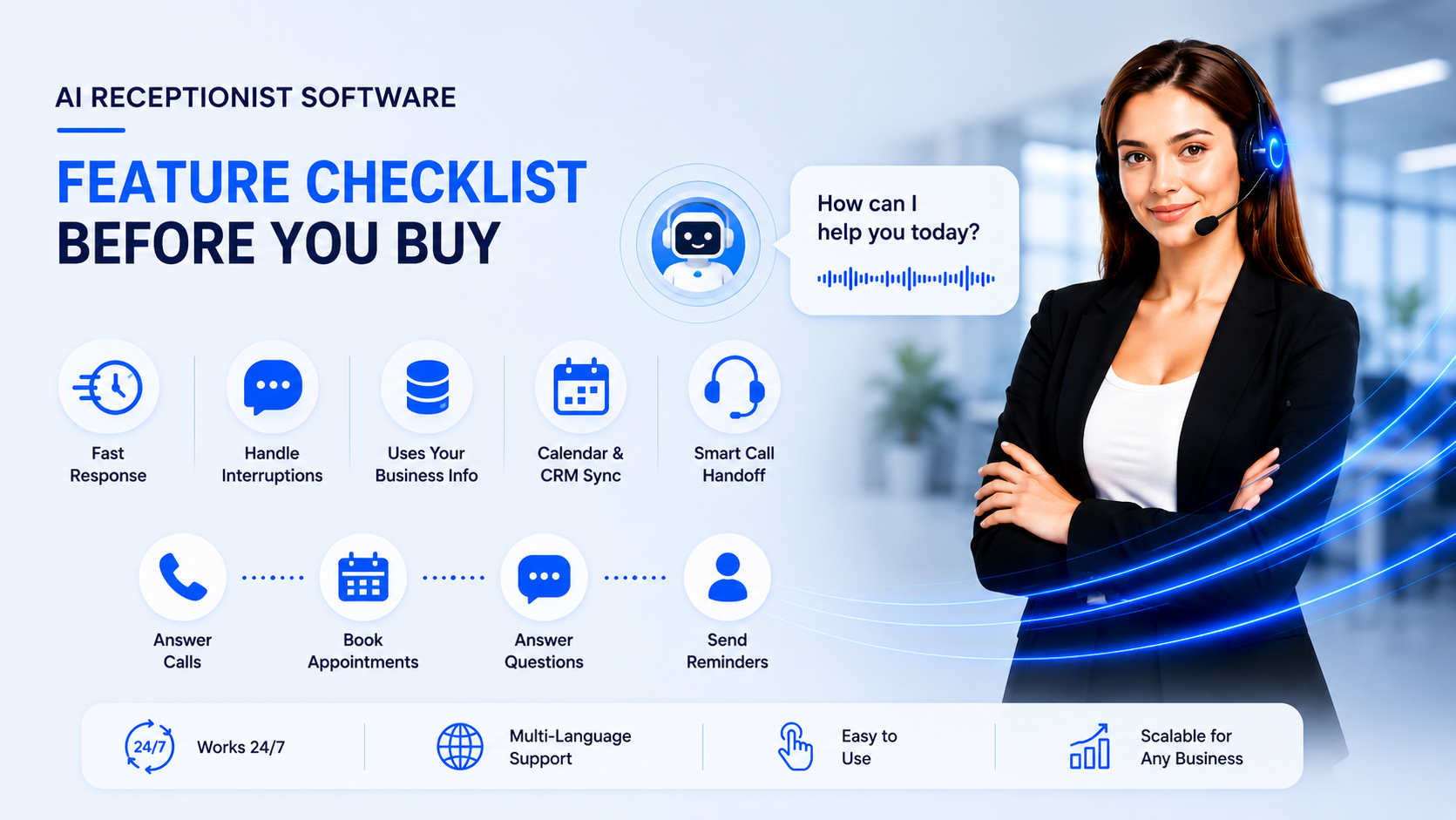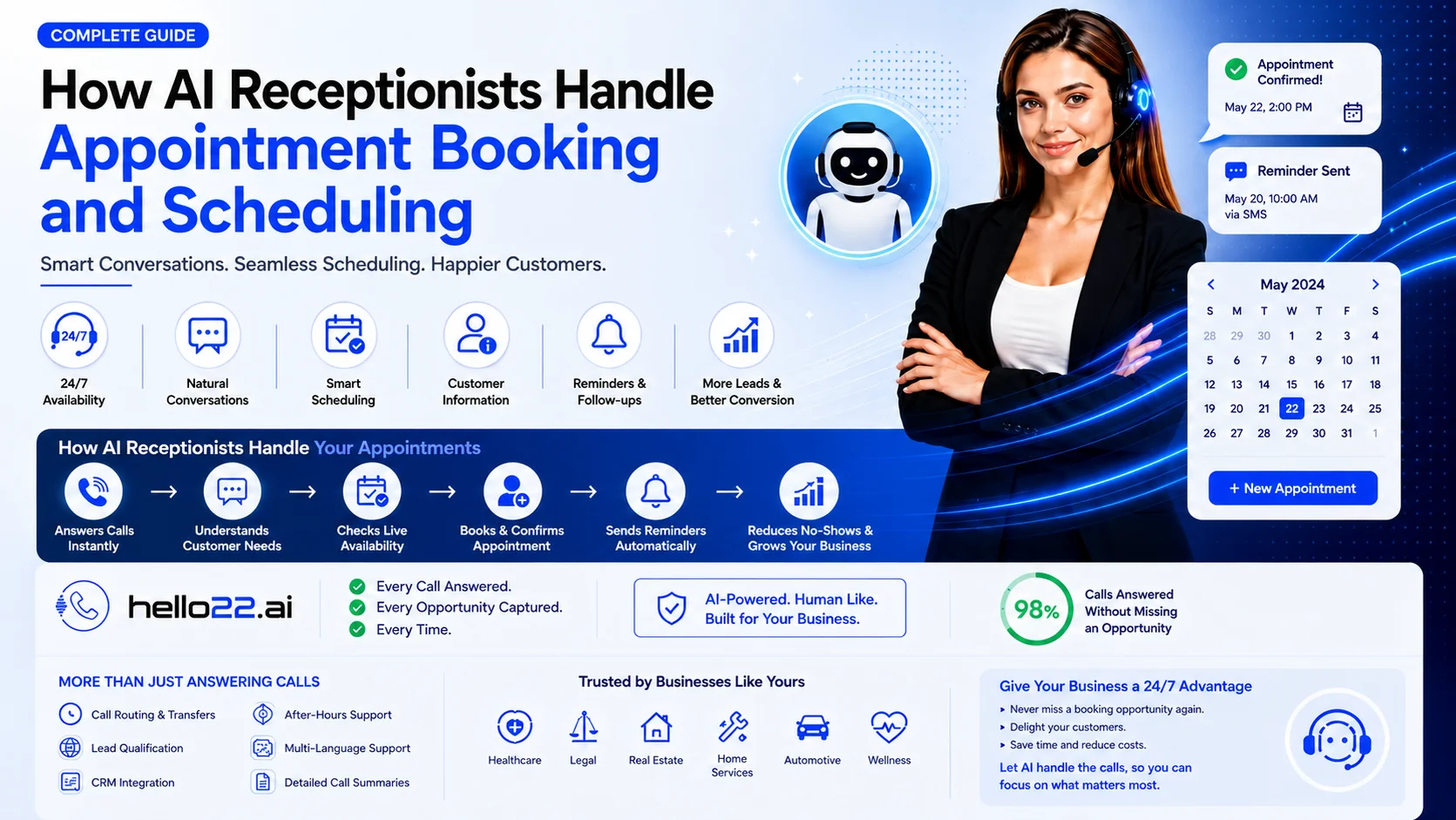

Choosing a virtual receptionist service comes down to testing conversation quality on a real trial, confirming pricing and contract terms in writing, checking that integrations actually sync in real time, and verifying how the provider handles call recording and data privacy, roughly in that order. Read – What is virtual receptionist
Picture a salon owner with three tabs open: three pricing pages, three feature lists that all use the same words 24/7, seamless, AI-powered, and no real way to tell which one will actually handle a Saturday morning rush without botching a booking. Feature lists all start to sound identical after the second one. What actually separates providers only shows up once you test them, ask specific questions, and read the fine print most people skip.
This guide turns that into a practical, ordered process: what to test first, what to ask on a sales call, what to check in the contract, and a checklist to run through before you sign anything.
Step 1: Decide What Type You Actually Need
Before comparing specific providers, confirm which category actually fits: a live human service, an AI receptionist, or a basic auto-attendant, since these are genuinely different products with different pricing and capabilities. Shopping across all three at once, without knowing which one you actually need, is how comparisons get confusing fast.
Step 2: Test Conversation Quality Yourself
Don’t take a demo video or a sales rep’s word for how well a system handles real calls. During a trial:
- Ask it a slightly unusual or ambiguous question and see whether it asks a sensible follow-up or guesses wrong.
- Try to book, then reschedule, an appointment and confirm it actually lands correctly in a calendar.
- Have someone call with a mild accent or from a noisy environment to see how accuracy holds up outside ideal conditions.
- Check what happens when you ask something entirely outside its scope: does it escalate cleanly, or improvise badly?
A fuller breakdown of what good actually looks like, including benchmark numbers for resolution rates and intent accuracy, is covered in this series’ guide to virtual receptionist quality; use it as your testing rubric during the trial. Read – What Is a Good Virtual Receptionist?
Step 3: Confirm Pricing and Contract Terms in Writing
Get the following confirmed in writing, not just quoted verbally on a call:
- The exact monthly rate and what’s included (minutes, features, integrations)
- Overage rates once you exceed included minutes or calls
- Setup or onboarding fees, if any
- Contract length and cancellation terms, including any early-termination fee
- Whether pricing changes automatically at renewal, and by how much
If a provider is vague or reluctant to put any of this in writing, treat that as a warning sign rather than a formality to skip.

Step 4: Check That Integrations Actually Sync in Real Time
A “CRM integration” claim on a features page can mean anything from genuine real-time, two-way sync to a delayed nightly export. During evaluation:
- Ask specifically whether calendar bookings sync instantly or with a delay.
- Confirm which CRMs and calendar tools are actually supported, not just “custom integrations available.”
- If you have an existing CRM, ask to see the integration working before committing, not after.
Step 5: Ask About Security, Privacy, and Call Recording Compliance
This is the step most comparison guides skip, and it matters. Ask any provider directly:
- Where call data and recordings are stored, and for how long
- Whether they hold relevant compliance certifications, such as SOC 2 or GDPR compliance, if you handle EU customer data
- How call-recording consent is handled matters because call-recording consent laws vary by U.S. state. Roughly 38 states follow a one-party consent standard, where only one participant needs to know the call is being recorded, while about a dozen states require all-party consent, meaning every caller must be notified. A business operating across state lines generally needs to plan for the stricter standard. This is general information, not legal advice. Confirm your state’s current requirements with a lawyer before finalizing how your provider handles recording.
- What happens to your data if you cancel the service
Step 6: Understand Setup, Onboarding, and Ongoing Support
Ask how long setup typically takes, what information you’ll need to provide, and whether updating the system later (new pricing, new hours, a new service) is something you can do yourself or requires contacting support each time. A provider that makes updates easy will stay accurate as your business changes; one that requires a support ticket for every small edit tends to fall out of date. Checkout – How Much Does a Virtual Receptionist Cost?
Step 7: Use the Free Trial Properly
A free trial is only useful if you stress-test it rather than just glance at it. During the trial period:
- Route your real call volume through it, not just a handful of test calls
- Test it during your actual busiest hours, not a quiet moment
- Have a few different people call, not just you, since you already know what to expect
If a provider doesn’t offer a genuine trial, or makes cancellation during the trial deliberately difficult, treat that as a signal worth weighing against everything else. Read – Why Are Businesses Replacing Traditional Virtual Receptionists with AI
Questions to Ask Every Provider
Bring this list to any sales call or demo:
- What happens when the system doesn’t understand a caller?
- Can I review past calls and correct the information it got wrong?
- What’s included at this price, and what costs extra?
- How does your system handle a call spike? Does quality change?
- What’s the cancellation process if this isn’t the right fit?
- Who owns the call data, and what happens to it if I leave?
A Practical Virtual Receptionist Choosing Checklist
| Check | Why It Matters |
| Tested conversation quality on a real trial | Demos are curated; real calls reveal real performance |
| Pricing and contract terms confirmed in writing | Prevents surprise charges after signing |
| Integrations verified as real-time, not delayed | A delayed sync creates double-bookings and stale data |
| Data privacy and call recording compliance confirmed | Protects the business from compliance risk |
| Setup process and ongoing support understood | Determines how easy it is to keep the system accurate |
| Cancellation and contract-length terms reviewed | Limits risk if the fit turns out to be wrong |
Where Hello22 AI Fits
Hello22 AI is built to hold up under this kind of evaluation: real-time calendar syncing, transcripts and call summaries you can review afterward, no lock-in contract, and SOC 2 and GDPR compliance. The 7-day free trial requires credit card, so you can run Steps 2 and 7 above against your own real call volume before committing to anything.
Final Thoughts
Choosing well comes down to testing rather than trusting. A real trial against real call volume tells you more in twenty minutes than any features page will in an hour of reading. Get pricing and contract terms in writing, ask directly about data privacy and call recording, and confirm integrations actually sync before you commit to anything long-term. Read – How Does a Virtual Receptionist Work?
None of this needs to take longer than a few days if you work through the steps in order, and a provider who resists straightforward answers to the questions above is telling you something worth listening to. Compliance requirements referenced here, particularly around call recording, vary by jurisdiction and change over time. Confirm current rules with a lawyer rather than relying on this or any other general guide.
❓ Frequently Asked Questions About Choosing a Virtual Receptionist
What’s the most important thing to test before choosing a virtual receptionist?
Conversation quality on a real trial, using your actual call volume and a few genuinely unusual questions, not just the polished demo a sales team shows you.
Should I choose a monthly or annual contract?
Month-to-month is generally lower risk while you’re still confirming fit, even if annual contracts offer a discount. Many providers offer both; it’s worth starting month-to-month and switching later if it’s clearly working.
What compliance certifications should a virtual receptionist provider have?
Look for SOC 2 compliance as a baseline data-security standard, and GDPR compliance if you handle any customer data from the EU. Ask directly rather than assuming a provider has these just because they’re common in the industry.
Is call recording legal for a virtual receptionist service?
It depends on your state. The U.S. splits into one-party consent states and roughly a dozen all-party consent states, and the rules can differ further for calls crossing state lines. This is general information, not legal advice; confirm current requirements with a lawyer.
How long should a virtual receptionist trial actually take to evaluate?
Long enough to route a meaningful chunk of real call volume through it, ideally covering your busiest period. A handful of test calls from yourself alone isn’t a representative trial.
What’s a red flag when comparing virtual receptionist providers?
Vagueness. A provider that won’t confirm pricing, contract terms, or data-handling practices in writing, or one that makes trial cancellation deliberately difficult, is usually signaling something worth taking seriously.
Can I switch virtual receptionist providers later if I choose the wrong?
Generally, yes, especially with month-to-month plans. Ask upfront what happens to your call data and configuration if you leave, so switching later isn’t harder than it needs to be.