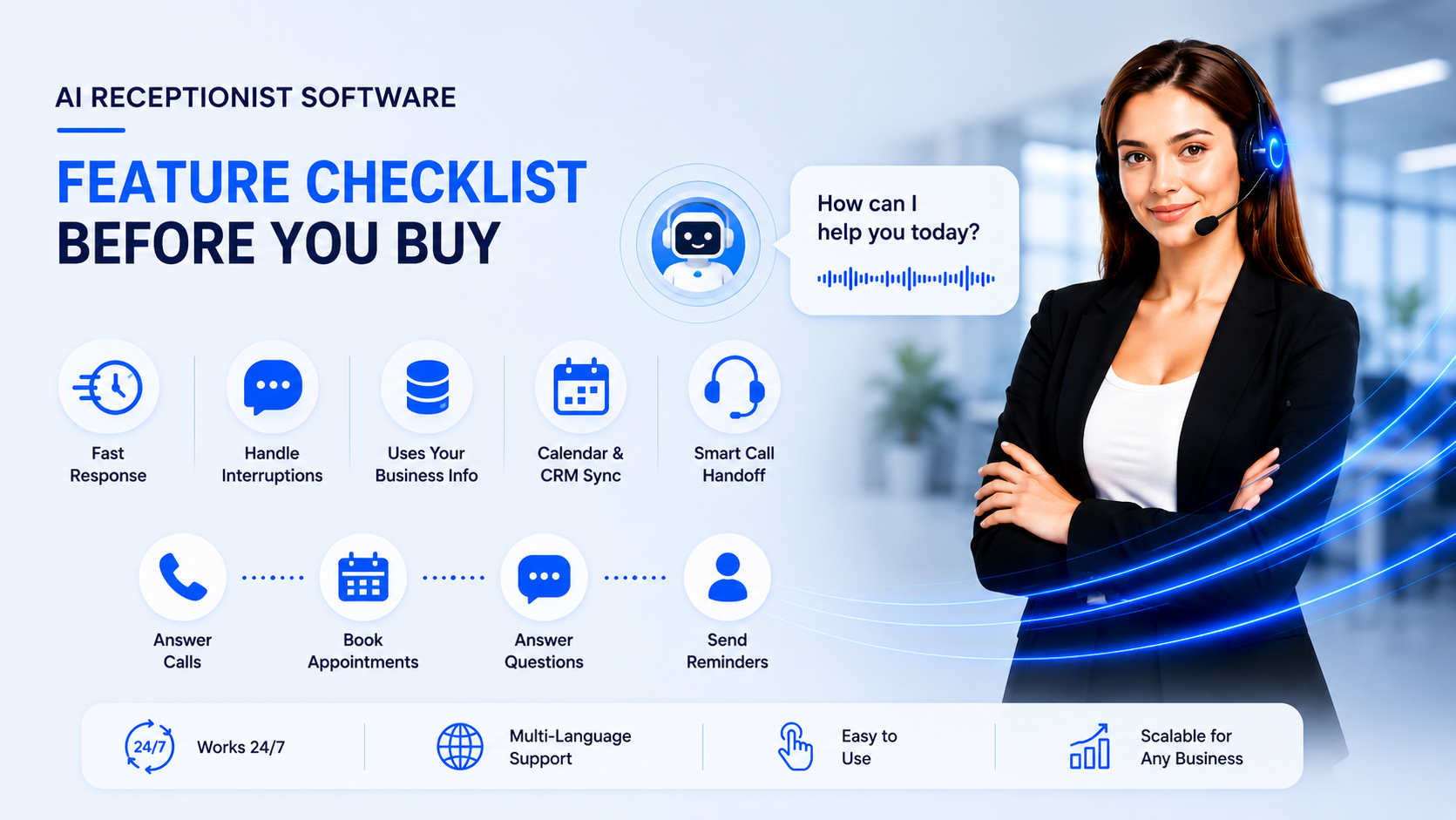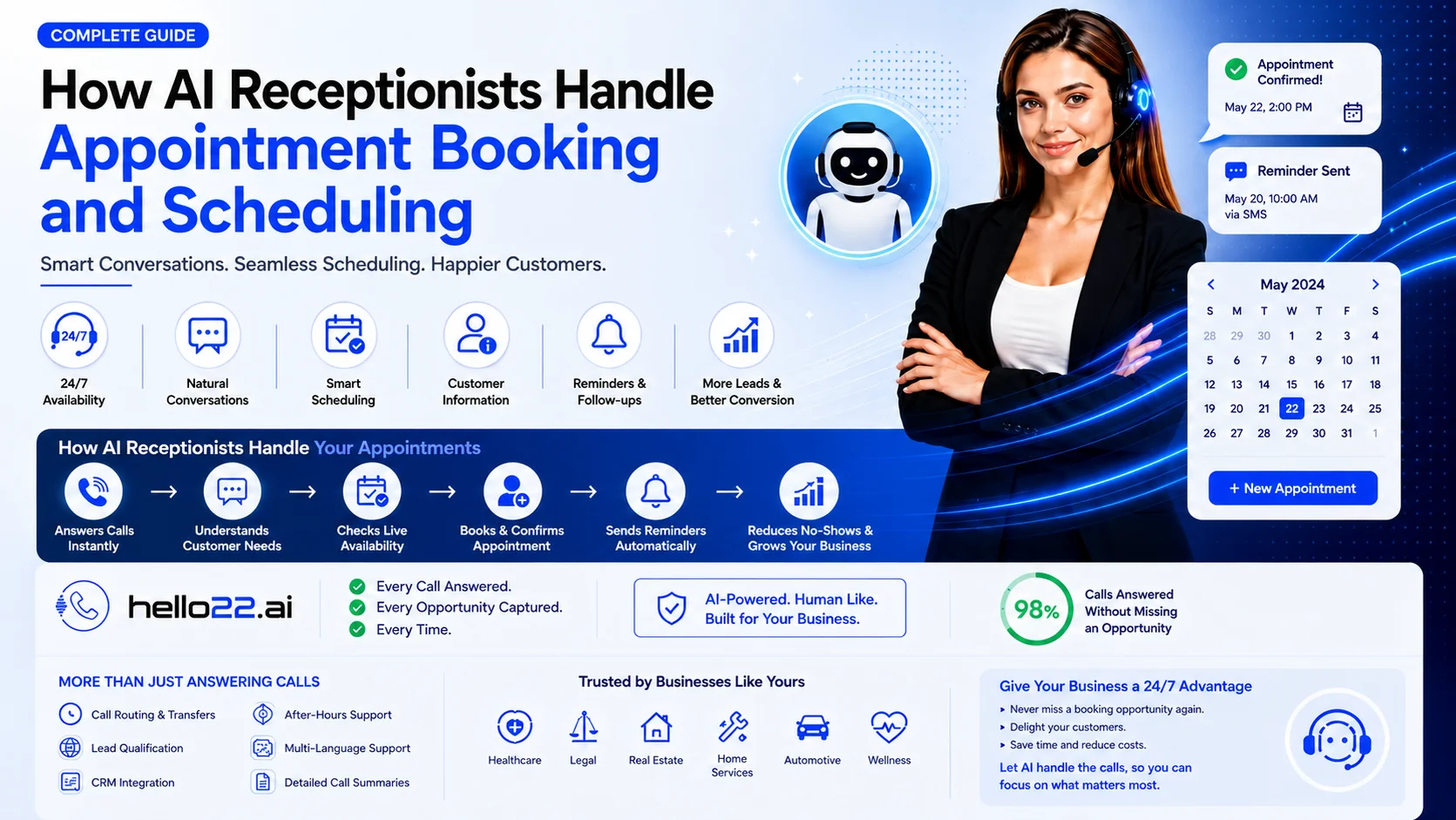

A good virtual receptionist answers quickly and consistently, actually understands what a caller needs rather than just catching the words, resolves most calls without needing to escalate, and hands off cleanly to a real person when a call genuinely requires one. Everything past that is detailed.
Picture a caller trying to book a weekend clean with a cleaning company. She explains what she needs, and the voice on the other end asks her to repeat it twice before finally getting it half right and booking the wrong day. She hangs up and calls the next company on her list. That’s not a virtual receptionist having a bad day; it’s a virtual receptionist that was never actually good, dressed up, accompanied by a friendly greeting.
This guide breaks down what separates a genuinely good virtual receptionist, human or AI, from one that just looks the part on a features page, including real benchmark numbers for conversation quality and honest signs that something isn’t working. Choosing among specific providers using a step-by-step evaluation checklist is covered in a separate guide later in this series.
📌 Key Takeaways: What “Good” Actually Looks Like
- Speed and consistency are the baseline: a good virtual receptionist answers quickly, every time, not just when call volume is low.
- Real conversation quality means understanding intent, not just transcribing words; industry benchmarks put strong intent-recognition accuracy at 90–97% for well-defined call types.
- A good AI receptionist resolves a meaningful share of calls without human escalation. Mature deployments typically land in the 40–70% containment range, higher for simple, structured tasks like booking.
- Good appointment handling checks real-time availability and confirms, rather than just taking down a request.
- Clean human handoffs matter as much as automation. A good system knows exactly when to hand off, and does it with context attached.
- Genuine customization means the receptionist reflects your actual business information and tone, not a generic script with your company name swapped in.
Speed and Consistency: The Baseline Every Good One Gets Right
Before anything else, a good virtual receptionist answers fast and answers the same way every time. A live human service that answers within a few rings during quiet hours but leaves callers waiting during a rush isn’t consistent. An AI receptionist that answers instantly at 3 p.m. and also at 3 a.m. is doing the one thing a virtual receptionist exists to do.
Consistency also means the same quality of interaction regardless of who’s calling or when, no “good days and bad days” depending on which agent picked up, and no drop in performance during a busy stretch.
Conversation Quality: Actually Understanding the Caller
This is where the real gap between good and mediocre shows up. A virtual receptionist that transcribes words accurately but misses what the caller actually wants isn’t good; it just sounds good on the surface.
For AI receptionists specifically, there are real numbers worth knowing rather than taking a vendor’s word for it. Industry benchmarking for voice AI puts strong intent-recognition accuracy at roughly 90–97% for well-bounded call types like appointment booking or order status, with mature, well-configured deployments resolving 40–70% of calls without needing to escalate to a human, and structured tasks like booking routinely running higher than that. Numbers below those ranges generally signal a system that hasn’t been properly trained on the business’s information, not a fundamental limitation of the technology.
For live human services, the equivalent quality signal is whether the agent asks intelligent follow-up questions rather than working rigidly off a script. A caller with an unusual request should get a thoughtful response, not a dead end.

Good Appointment Handling Looks Like This
A good virtual receptionist doesn’t just note “they want an appointment” and leave it for someone else to sort out later. It:
- Checks real, current availability before offering a time slot
- Confirms the booking back to the caller before ending the call
- Writes the appointment directly into the connected calendar, not a note for someone to transcribe later
- Sends a confirmation to the caller through a channel they’ll actually see
If a virtual receptionist books appointments that then need to be manually re-entered or double-checked, it isn’t actually doing the job; it’s adding a step, not removing one.
Clean Human Handoffs: Knowing When to Get Out of the Way
Good doesn’t mean handling everything alone. It means knowing precisely when not to. A well-built virtual receptionist recognises calls that need a real person, a distressed caller, an unusual request outside its scope, a VIP client, and transfers them cleanly, with the relevant context already attached, rather than making the caller repeat everything to whoever picks up next.
A virtual receptionist that either escalates everything (defeating the purpose) or escalates almost nothing (forcing itself through calls it can’t actually handle) both fail this standard, just in opposite directions.
Genuine Customization vs. a Script With Your Logo On It
Surface-level customization, a greeting with your business name inserted, isn’t the same as real customization. A good virtual receptionist reflects:
- Your actual current pricing, hours, and services, not generic placeholders
- The tone your business actually uses, whether that’s formal or casual
- Business-specific rules which call transfers, which don’t, what counts as urgent
This is also where a lot of quality problems trace back to setup rather than the technology itself: a poorly configured AI receptionist trained on outdated information will confidently give wrong answers, and that’s a setup failure, not proof AI receptionists don’t work.
Integrations That Actually Sync, Not Just Connect
A “CRM integration” that only pushes data one-way, or with a delay, isn’t meaningfully useful. Good integration means real-time, two-way sync: a booked appointment appears in the calendar instantly, and a caller’s details land in the CRM the moment the call ends, not on a batch update hours later.
Support and Accountability When Something Goes Wrong
Every virtual receptionist, human or AI, will occasionally get something wrong. What separates a good provider is what happens next: can you review the call, correct the information it was working from, and see the fix take effect quickly? A provider with no visibility into past calls and no easy way to update the receptionist’s information makes every mistake a repeat mistake.
Red Flags: Signs a Virtual Receptionist Isn’t Good
Watch for these honest warning signs, whether you’re testing a live demo or already using a service:
- Callers regularly have to repeat themselves more than once
- Appointments get booked incorrectly or need manual double-checking
- The system escalates almost every call, or almost never escalates any
- Responses sound generic rather than reflecting your actual business
- There’s no easy way to review calls or correct wrong information afterward
- Multiple simultaneous calls (for AI) result in noticeably worse performance
Any one of these on its own might be a setup issue worth fixing. Several of them generally point to a system or a provider that isn’t good.
Where Hello22 AI Fits
Hello22 AI is built around the standards above rather than just the feature list: it’s trained on your actual business information rather than a generic script, checks real calendar availability before booking, and hands off to your team with full call context when a conversation needs a human. Call summaries and transcripts are available afterward so mistakes can be caught and corrected quickly. You can judge the conversation quality directly during the 7-day free trial rather than taking any of this on faith.

Final Thoughts
Good isn’t a feature list; it’s speed, real understanding, clean handoffs, and honest accountability when something goes wrong, consistently, not just in a demo. The benchmark numbers in this guide give you something to measure against rather than trusting a vendor’s own claims at face value, and the red-flag list gives you something concrete to test before committing to anything long-term.
The next guide in this series, “How to Choose a Virtual Receptionist Service,” turns these quality standards into a practical, step-by-step evaluation process for comparing specific providers. Benchmark figures referenced here reflect published industry voice-AI research as of mid-2026 and will shift as the technology matures; treat them as a reference point, not a fixed target.
❓ Frequently Asked Questions about Virtual Receptionist Quality
Q.1 How do I know if an AI receptionist actually understands callers?
Test it with real, slightly unusual requests during a trial or demo, not just simple scripted questions. A good one asks a sensible clarifying question when it’s unsure; a weak one either guesses wrong or asks the caller to repeat themselves repeatedly.
Q.2 What’s a good call resolution rate for a virtual receptionist?
For AI receptionists, mature and well-configured deployments typically resolve 40–70% of calls without human escalation, with simple structured tasks like appointment booking often resolving at a higher rate than that.
Q.3 Should a virtual receptionist sound completely human?
Not necessarily. What matters more is whether it understands and resolves the call correctly. A natural-sounding voice helps the experience, but accuracy and follow-through matter more than whether a caller can tell it’s AI.
Q.4 How much customization should I actually expect?
A good virtual receptionist should reflect your real hours, pricing, services, and tone, not just your business name inserted into a generic script. If setup only asks for surface details, quality will likely reflect that.
Q.5 What happens when a good virtual receptionist doesn’t know an answer?
It should say so honestly and either take a message or escalate to a real person, rather than guessing. A system that confidently gives wrong information is a bigger risk than one that admits it doesn’t know.
Q.6 Is 24/7 availability alone enough to call a virtual receptionist good?
No. Being available around the clock is table stakes, not a quality indicator. A system that answers instantly at 3 a.m. but consistently mishandles the conversation isn’t good just because it was there.
Q.7 Can a live human virtual receptionist be worse than an AI one?
Yes. Quality depends on training, script quality, and consistency, not just whether a human or AI is on the line. A poorly trained live agent working from a thin script can perform worse than a well-configured AI receptionist, and vice versa.