A virtual receptionist works by taking over your business number through call forwarding, then answering the call either as a live remote agent or an AI voice agent, figuring out what the caller needs, and completing it: booking an appointment, taking a message, or transferring to your team. The whole thing happens without the caller ever reaching your office directly.
Picture a plumber halfway under a kitchen sink when the phone rings. He can’t answer it, and even if he could, he shouldn’t stop mid-repair to take down a stranger’s address. That’s the exact moment a virtual receptionist is built for: the call still gets answered, the job still gets booked, and he finds out about it the second he’s free, instead of finding out never.
This guide walks through what actually happens on that call, from the first ring to the final summary landing in someone’s inbox, covering both how a live human agent handles it and how an AI receptionist handles it, since the mechanics differ more than most explanations let on.
📌 Key Takeaways: The Virtual Receptionist Process in Brief
- A virtual receptionist works by forwarding your business number, so calls reach the service without the caller noticing anything different.
- A live human agent answers using a script and your business’s information; an AI receptionist answers using speech recognition and a language model to understand and respond in real time.
- Appointment booking works by syncing directly with your calendar (Google Calendar, Outlook, or an industry-specific tool) and checking real availability before confirming.
- After the call, a summary is typically sent by SMS, email, or WhatsApp, and details can be logged straight into a connected CRM.
- Urgent or sensitive calls are handed off to a real staff member, whether the first responder was human or AI.
- Setup for an AI receptionist usually means training it on your business information; setup for a live service usually means writing and reviewing a script.
The Call Flow: From Ring to Resolution
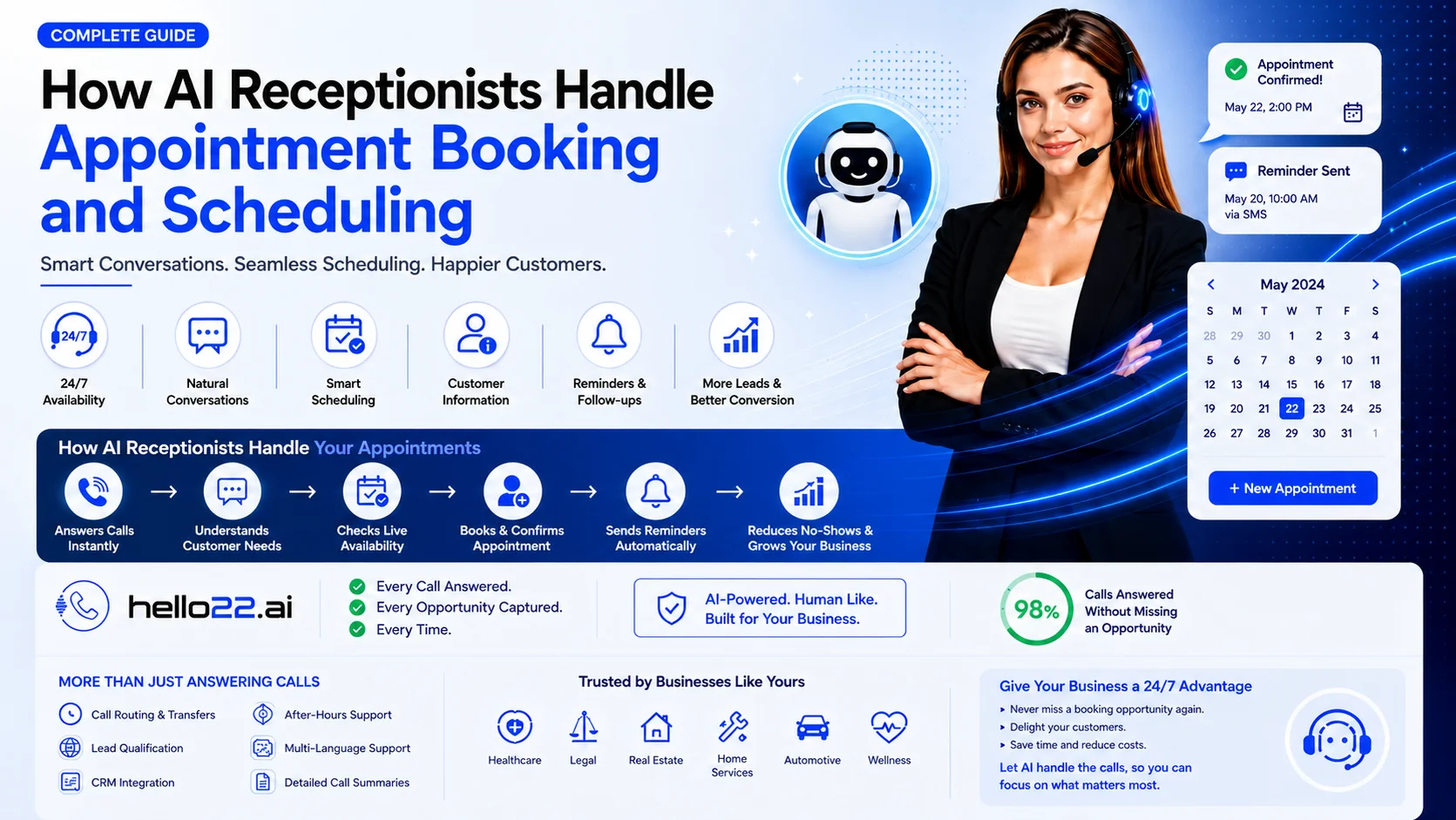
Strip away the branding, and every virtual receptionist, human or AI, follows roughly the same shape:
- The call arrives. Your existing business number is forwarded to the virtual receptionist’s line. The caller dials the number they already know; nothing on their end changes.
- Someone (or something) answers. A live agent picks up using your business’s name and a greeting you’ve approved, or an AI system answers instantly using a pre-set greeting.
- The caller explains what they need. The agent or AI listens and asks clarifying questions if the request is unclear: a new booking, a general question, or an existing customer following up.
- The request gets actioned. This is where the call resolves: an appointment gets booked into a real calendar, a question gets answered from the business’s information, or a message gets taken.
- Urgent calls get transferred. If the rules say a call should reach a real person, a VIP client, an emergency, or anything outside the script, it’s routed to a configured phone number or department.
- A record is created. Details of the call are logged, and a summary is sent to the business, so nothing said on the call disappears once it ends.
The difference between providers isn’t really the shape of that flow; it’s what happens inside steps 2 through 4.
How a Live Human Virtual Receptionist Handles a Call
With a live service, a real person, usually working from a call centre, sometimes from home, answers using a script your business has written and approved in advance. They’re trained on your company name, your hours, your pricing, and common questions, and they follow branching logic: if the caller asks X, say Y; if they want to book, check availability and confirm.

Because a person is doing the listening and deciding, live services handle ambiguity and emotional nuance well, a frustrated customer, an unusual request, but they’re also bound by shift schedules, and pricing is typically per minute or per call, which adds up quickly at higher volumes.
How an AI Receptionist Handles a Call
An AI receptionist runs through four things during a call, and none of them require you to understand the underlying engineering:
- Listening. The system converts the caller’s spoken words into text in real time, working through background noise, different accents, and pauses.
- Understanding. It works out what the caller actually wants, not just the words used, but the intent behind them. “I need someone to look at my hot water system” and “my heater’s broken” are treated as the same request.
- Deciding. Based on the business’s configured rules and information, it decides what to do next: answer a question, ask a follow-up, check calendar availability, or flag the call for a human.
- Replying. The response is spoken back in a natural-sounding voice, and the loop repeats for as many turns as the conversation needs.
This whole cycle typically happens quickly enough that the conversation feels like a normal phone call rather than a laggy bot exchange. For a closer look at the technology powering each of those four steps, hello22.ai’s guide to how AI receptionists work goes deeper into the mechanics.
Both live and AI virtual receptionists usually run on a VoIP (Voice over Internet Protocol) connection under the hood, the same underlying technology defined by the FCC as calls carried over the internet rather than a traditional phone line, which is what allows either kind of service to answer your number from anywhere with an internet connection.
How Appointment Booking Actually Happens
Booking isn’t a separate add-on bolted onto the call; it happens live, inside the conversation. Whether the receptionist is human or AI:
- The caller asks for an appointment, or the agent offers to book one.
- The system checks real-time availability in your connected calendar, commonly Google Calendar, Outlook, or an industry-specific scheduling tool.
- Available slots are offered to the caller.
- Once the caller picks one, it’s written directly into your calendar, not just noted down for someone to add later.
- A confirmation goes to the caller, typically by SMS or email.

The part that actually prevents double-bookings is the real-time, two-way sync; the receptionist isn’t working from a calendar snapshot that could be a few hours stale.
What Happens After the Call: Summaries, CRM Updates & Handoffs
The call itself is only half the process. What happens right after determines whether the business actually acts on it:
- Call summaries. A short write-up of who called, what they needed, and what was done was sent through a channel the business has chosen, commonly SMS, email, or WhatsApp.
- CRM logging. If the business has a connected CRM, the caller’s details and the outcome of the call can be written straight into it, so a lead doesn’t just sit in a call log nobody checks.
- Human handoff. Anything flagged as urgent or outside the system’s scope gets passed to a real staff member, either transferred live, mid-call, or flagged immediately afterward with full context attached, so the team isn’t starting from zero.
Human vs. AI Virtual Receptionist: How the Workflow Differs
| Step | Live human receptionist | AI receptionist |
| Answers the call | A trained person, from a call centre or remote location | Software, instantly, 24/7 |
| Understands the request | Human judgment and a written script | Speech recognition + language model |
| Handles multiple calls at once | No one call per agent | Yes, no queue for the caller |
| Books appointments | Requires a person to review availability and confirm bookings by hand | Syncs and books in real time during the call |
| Handles unusual or emotional calls | Generally strong human judgment | Generally weaker flags for human handoff |
| Setup | Script writing and agent training | Business information and rules configured into the system |
| Typical pricing | Per minute or per call | Flat monthly plan, often with a minutes allowance |
Setting One Up: What’s Actually Involved
Setup differs by type, but neither is a heavy technical lift for the business owner:
- For a live service, you provide your business information, write (or approve) a call script, and set the rules for when a call should be transferred.
- For an AI receptionist, you supply the same core information — hours, services, pricing, FAQs — which the system uses to answer questions accurately, plus your calendar and any CRM you want connected. Most platforms handle this through a guided setup rather than requiring a developer.
In both cases, accuracy depends entirely on how complete and current the information you provide is. A script or AI trained on outdated pricing will confidently give the wrong answer.
Where Hello22 AI Fits
Hello22 AI runs the AI-receptionist version of this process: it answers using your forwarded business number, listens and responds using natural-sounding conversation, checks real availability before booking into your calendar, and sends a call summary by WhatsApp, email, or SMS once the call ends. It integrates with Nexleon CRM by default, with custom CRM integration available on higher plans. Complex calls are handed to your team rather than forced through the AI. You can test the full flow against your own call volume during the 7-day free trial, credit card required.
Final Thoughts
However, the branding differs; every virtual receptionist moves through the same basic shape: answer, understand, act, hand off, and record. The real differences show up in who or what is doing steps two and three, and how fast and accurately they do it. A live agent brings human judgment and costs more at volume; an AI receptionist answers instantly and scales without a queue, but leans on a good setup to stay accurate.
Before choosing between the two, it’s worth watching a real demo call end-to-end rather than reading a feature list; the workflow only tells the full story in motion. Setup details and integrations referenced here reflect Hello22 AI’s platform as published in August 2026; confirm current specifics directly with any provider before committing.
📌 Frequently Asked Questions: Virtual Receptionist Process
-
Does a virtual receptionist need a new phone number?
No. Most services work by forwarding your existing business number, so callers dial the number they already know and never notice a difference on their end. -
How does an AI receptionist know what to say?
It’s trained on information your business provides — hours, services, pricing, FAQs — and uses that, combined with real-time speech understanding, to generate accurate, natural-sounding responses during the call. -
Can a virtual receptionist transfer a call to a real person?
Yes. Both human and AI virtual receptionists can be configured to transfer specific types of calls — emergencies, VIP clients, anything outside the script — to a real staff member, either live or immediately after the call. -
Does a virtual receptionist book straight into my actual calendar?
When set up properly, yes, the system checks real-time availability in a connected calendar like Google Calendar or Outlook and books directly into it, rather than just taking down a request for someone to add manually later. -
How long does it take to set up a virtual receptionist?
It varies by provider and complexity, but many AI receptionist platforms can be configured within minutes to a few hours for straightforward use cases, since the core requirement is business information rather than custom development. -
What happens if the system doesn’t understand a caller?
A well-built virtual receptionist, human or AI, is designed to ask a clarifying question rather than guess, and to escalate to a human when it genuinely can’t resolve the call. -
Do I need any technical skills to set one up?
Generally no. Most platforms, including AI receptionist services, use a guided setup process rather than requiring coding or developer involvement.