Here’s what changed with AI receptionists in 2026: they no longer just answer your phone; they finish the job (booking the appointment and taking the caller’s details); they’ve become cheap enough for any small business; they speak your customers’ languages. They are available in versions built for specific industries instead of offering you one size that fits all.
In terms of government action, we have seen in Europe; now there’s a law saying an AI must tell callers it’s an AI (Article 50 of the EU AI Act). What we are saying here is that if we talk about AI receptionists or voice agents, they are no longer entities that belong to the future but something that is useful for most businesses now, has certainly gained commercial attention, and is becoming an essential business tool, like email or online booking.
Why should you care if you run a salon, a plumbing business, a clinic, or a small firm? Because your competitors are quietly switching this on. McKinsey’s latest global survey found 88% of organizations now use AI somewhere in their business, up from 78% a year earlier. And Gartner predicted that businesses would save $80 billion on call-handling wages in 2026 thanks to AI that can hold a conversation. That saving is happening on ordinary business phone lines, the kind that rings in your shop.
This guide explains the latest AI receptionist trends that actually matter in 2026 and beyond. These concentrate specifically on what the technology can now do, what it costs, real examples of how businesses like yours are using it, and where it still falls short, and also include a simple checklist to help you decide if you need it or not for your own business.
📌 Key Takeaways
- AI phone answering is growing fast: the market is expected to jump from $2.4 billion in 2024 to $47.5 billion by 2034 (Market.us), and prices have dropped, with most small businesses paying under $100 a month.
- The big change in 2026: AI receptionists now finish tasks—they book appointments, save caller details, and can even send a payment link instead of just taking a message.
- New systems speak multiple languages, so customers who aren’t confident in English can still book with you, even at 9pm.
- Industry-specific AI receptionists for dental, medical, and trades businesses are available, helping them understand callers better than generic AI systems.
- The best setup is simple: let the AI handle everyday calls, and have it pass tricky conversations to a real person.
- New EU rules (from August 2, 2026) require AI phone systems to tell callers they’re speaking with AI—and being transparent works better anyway.
The Big Picture: AI Receptionist Went from Being a “Fancy Gadget” to “Normal Business Tool”
Two years ago, an AI answering a business phone was something that belonged to the future, and most businesses thought it was not for them, and they could still wait to embrace this technology. However, in 2026, it’s not the case. The research firm Market.us valued this market at $2.4 billion in 2024 and expects $47.5 billion by 2034, growing about a third every year. What does that mean for you in practice? Lots of companies fight for your business, which pushes prices down and quality up every few months. If you’re still deciding whether AI is the right choice, our comparison of AI Receptionist vs Human Receptionist explains the key differences, costs, and benefits for small businesses.
Picture this moment. It’s 7pm. A plumber is under a sink, hands full, and his phone rings: a new customer with a burst pipe, worth a few hundred dollars. Two years ago, that call went to voicemail, and the customer called the next plumber on Google. In 2026, an AI answers on the first ring, sounds friendly, books the job for the morning, and texts the plumber the details. That one saved call often pays for the whole month for a small solo-owner business. The six trends mentioned below will make the whole scenario even clearer to you:
AI Receptionist Trends You Must Know About

Trend 1: The AI Doesn’t Just Answer the Call It Finishes the Job
The biggest change that has occurred in the evolution of Ai receptionist technology is easy to explain with a before-and-after example.
Before, the AI technology was not fully developed, and if it answered a call, it was likely to say, “I’ll share your message.” Someone still had to call back, book the appointment, and enter the details into a computer. This is exactly why businesses lose valuable leads after unanswered calls, as explained in our guide on What Happens When Your Business Misses a Phone Call.
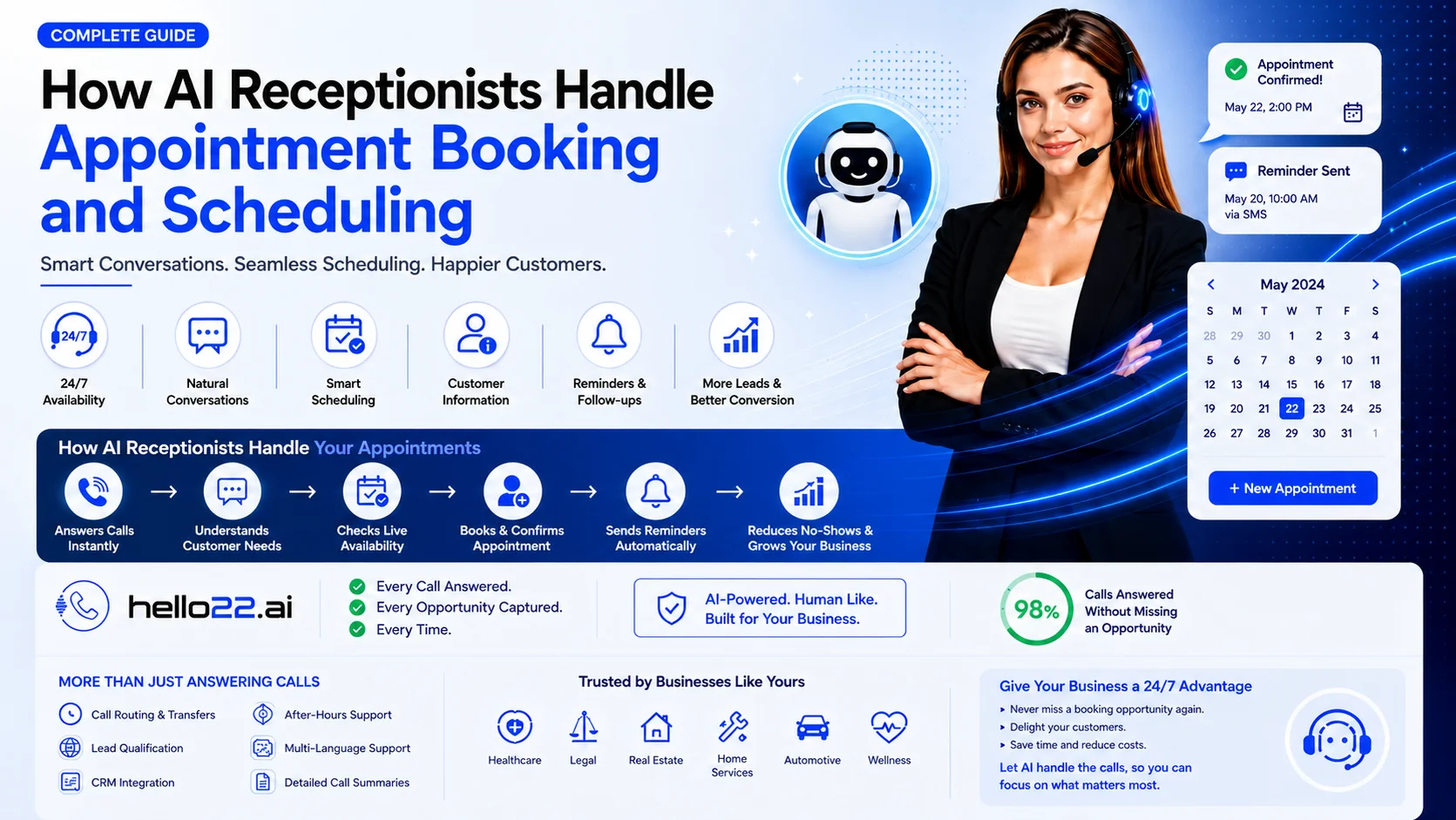
After (2026): At present, technology has grown and is more mature. Now, if a caller is in communication with an AI receptionist and says, “Can I get a haircut Thursday afternoon?” The AI voice receptionist working for the barber salon goes on to check the calendar, having all the schedules along with empty slot details; offers 2:30 pm; books it; and sends the customer a confirmation text. The salon owner has to do nothing. Some systems for clinics and dental offices go further: If they spot an unpaid bill, they text the caller with a secure link to pay for it. Learn more about the technology behind this in our guide: How Do AI Receptionists Work?
And there’s compelling proof this kind of help works. A major study from the National Bureau of Economic Research looked at thousands of customer service workers and found that AI helped them solve 14% more problems per hour and made the newest staff 34% faster because the AI does the routine part while people handle the rest.
A simple test when you’re considering getting a subscription for an artificial intelligence-based receptionist: do not forget to ask the prospective provider, “What happens after the call?” If the answer is “We send you a message”, that’s old technology. If it’s “the booking lands in your calendar and the customer’s details land in your system”, that’s the current one.
Trend 2: You Can’t Tell It’s a Robot Anymore
The expected stiff robotic voice with awkward pauses is disappearing for sure from modern AI receptionists, and it is another big positive. The newest AI voices sound warm. Natural conversations are one of the biggest Benefits of an AI Receptionist, helping businesses deliver a better customer experience. They become astonished to see that they can interrupt an AI voice agent mid-sentence, and they adjust just like a person would. In case you want an AI receptionist agent, go for the option that offers natural voices and instant replies as the new minimum standard.
One honest warning, though: you should know that the quality still varies a lot between companies. The only reliable test is to phone one yourself. Every quality AI receptionist provider has a demo option, and you must use it. If you notice a lag or a robotic tone, your customers will too. Trust your ears over any brochure.
Trend 3: It Speaks Your Customers’ Languages
Language support used to cost extra. Now it comes standard since new AI voice systems in 2026 can handle anywhere from 5 to 10 languages or even more.
Here’s why your AI receptionist’s ‘multilingual’ support matters more than it sounds. Think of a customer whose English isn’t strong. For years, that person heard an English-only voicemail, felt awkward, and hung up, and the worst part is that you never even got to know that you lost them. Now they can book in their own language, at any hour. If you serve a multicultural area and know that most of the US, the UK, Canada, and Australia are like this, it matters.
Trend 4: Built for Your Industry or Tailored to Your Business
A dentist’s phone and a plumber’s phone would ask completely different questions. That is why AI receptionists that are customizable to specific industries are starting to become more popular than general receptionists. Companies can have their own customizable AI voice receptionist according to the industry they work in, such as dentists, plumbers, real estate agents, lawyers, etc.
Simultaneously, several top AI receptionist companies provide tools that can learn about your company, services, policies, and procedures. The AI can use this information to respond according to your business standards and professionalism level rather than depending on generic responses. Conversations become more accurate, pertinent, and consistent with your company’s operations as a result.
Trend 5: Robot + Human is the Winning Team
Forget “will AI replace people?” The setup winning in 2026 comprises each of the two, your human team and AI receptionist, doing what they’re best at, respectively. The AI takes the everyday calls, bookings, “Are you open Saturday?” and “How much is a service?” which are usually 6 to 8 calls out of every 10. The moment a call is tricky, upset, or important, the AI passes it to a real person, along with the caller’s name and related important information, so nobody has to repeat themselves. Gartner expects this to keep growing, predicting that by 2028, most customer service will start with a conversation with AI.
For your staff, this isn’t a threat; it’s a relief since the human receptionist stops being interrupted 30 times a day with “What are your hours?” and spends time on the customers who actually need a human.
Trend 6: New Rules: The AI Has to Say It’s an AI (Reveal Its Own Identity)
Regulation caught up this year. In the EU, a law called the AI Act (Article 50) took effect on August 2, 2026: if an AI is talking to a person, it has to make that clear, unless it’s already obvious. The US, UK, Canada, and Australia don’t have this rule yet, but it’s clearly the direction things are heading.
Our advice, wherever you are: do it anyway. A simple “Hi, I’m the AI assistant for Smith Plumbing, and I can book you in or take your details” works better than pretending. Callers who know they’re talking to an assistant get to the point faster and never feel tricked. When comparing providers, also ask two plain questions: “Where is my call data stored?” and, if you’re in healthcare or law, “Do you meet my industry’s privacy rules?” A good AI receptionist software answers without jargon.
The Honest Bit: What It Still Can’t Do
The truth is that no one should try to convince you that AI receptionist tools are magical or will make you wealthy in a matter of days. Even the best systems occasionally mishear a noisy job site, an unusual name, or two people talking at once. Angry customers, complicated complaints, and delicate conversations still need a human, which is why the “handover to a real person” feature matters more than any other.
Moreover, be aware of the fact that the quality differs hugely between providers; therefore, before you choose, make a payment for your AI-powered receptionist. It is imperative that you take a free trial.
And the AI only knows what you teach it. Spend an hour telling it your prices, hours, and services, or it will give thin answers no matter what “instant setup” promised. Finally, be wary of amazing-sounding numbers on sales pages unless a trustworthy independent source backs them up.

A Simple Checklist Before You Choose One
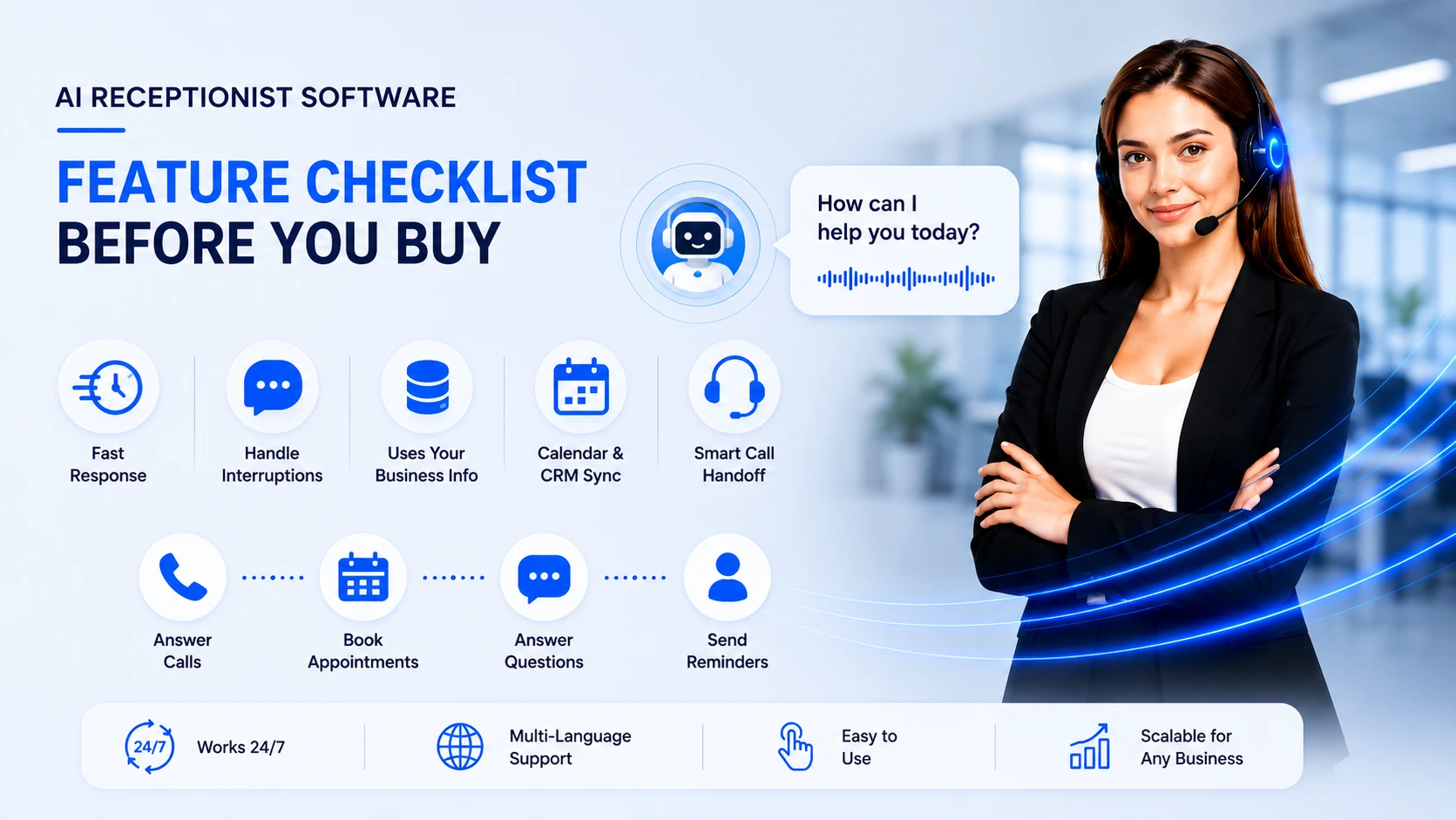
- Does the AI actually sound human? You don’t want callers to feel like they’re talking to a robot. Listen to a demo call first and see how natural the voice, pauses, and responses actually sound.
- Does it finish the job? Bookings should land in your actual calendar, and details of each communication in your inbox.
- Are there any interruptions? Natural voice, no lag, and no crashes.
- Does it speak your customers’ languages? Match it to who actually calls you.
- Test it with your real questions. Test it with the ten most common ones that your customers are likely to ask. Evaluate the answers.
- Does it hand over gracefully? Tricky calls should reach a human, with the caller’s details attached.
- Can it be upfront about its own identity? It should be able to tell callers it’s an AI if needed.
- Check the minutes, not the price tag. A cheap plan with too few minutes costs more than an honest one.
- Can you train it to get better? The best AI receptionists should let you feed them new information, update business rules, and improve how they handle calls over time.
Where Hello22 AI Fits
We’re Hello22 AI, and everything above is what we build: an AI receptionist that answers your calls 24/7, books appointments straight into your calendar, saves every caller’s name and details, answers your common questions, and passes the tricky calls to you or your team if needed, with multilingual voices and a summary of every call sent to you by text, email, or WhatsApp. Another positive is that our plans are affordable and can be customised to suit your business needs. The 07-day free trial handles your real calls, so you can run the checklist above on us before paying a cent. That’s exactly how we’d tell you to judge anyone in this market, including us.
Final Thoughts
Here’s the crux of this article: AI receptionist trends you can’t ignore in 2026: It has gone from once being seen as a futuristic tool to an essential business. It finishes calls instead of just answering them, costs less than a night out each month, speaks your customers’ languages, works best when it’s built for your industry, and teams up with your staff rather than replacing them. Even though the government has realized its potential and seeing how the huge number of businesses are adopting it in Europe, there is a law in existence that mandates AI to reveal its own real identity. In case you have not adopted AI receptionist technology, it’s ok.
But remember, waiting has a price now. Your callers may already be comparing you with businesses that answer on the first ring, even at midnight. If you fall behind, your competition is likely to get ahead in adoption. This is especially true if you’re a small or mid-sized business, and here Hello22 AI could be a good fit for your business if you’re looking for a feature-rich, affordable AI receptionist that still delivers a professional and top experience in 2026.
❓ Frequently Asked Questions
Which AI receptionist trends will be most prevalent in 2026?
The biggest AI receptionist trends in 2026 include AI that completes bookings and payments instead of just taking messages, lower pricing that makes AI affordable for most small businesses, more natural-sounding voices, multilingual support, industry-specific AI receptionists, and compliance with new EU rules that require AI systems to identify themselves to callers.
How big is the AI receptionist market?
According to Market.us, the broader voice AI market was valued at $2.4 billion in 2024 and is projected to reach $47.5 billion by 2034. As competition increases, prices continue to become more affordable for small businesses.
Will an AI receptionist replace my staff?
No. The most effective approach is combining AI with human staff. AI handles routine calls such as bookings, opening hours, pricing questions, and lead capture, while your team focuses on more complex conversations after receiving the caller’s details.
Is it necessary for an AI receptionist to identify itself to callers?
In the European Union, yes. From August 2, 2026, AI systems used on phone calls must identify themselves. In many other regions it is not yet required, but being transparent helps build trust and creates a better customer experience.
How do I choose an AI receptionist in 2026?
Choose an AI receptionist that sounds natural, supports multiple languages, integrates with your calendar for automatic bookings, answers common customer questions, transfers complex calls to a human, includes enough monthly minutes for your business, and offers a free trial before you commit.
How much does an AI receptionist cost in 2026?
Most AI receptionists cost between $30 and $300+ per month, depending on call volume and features, with many small businesses paying under $100 per month. For comparison, the median annual salary of a full-time receptionist in the United States is about $37,000, according to the U.S. Bureau of Labor Statistics.